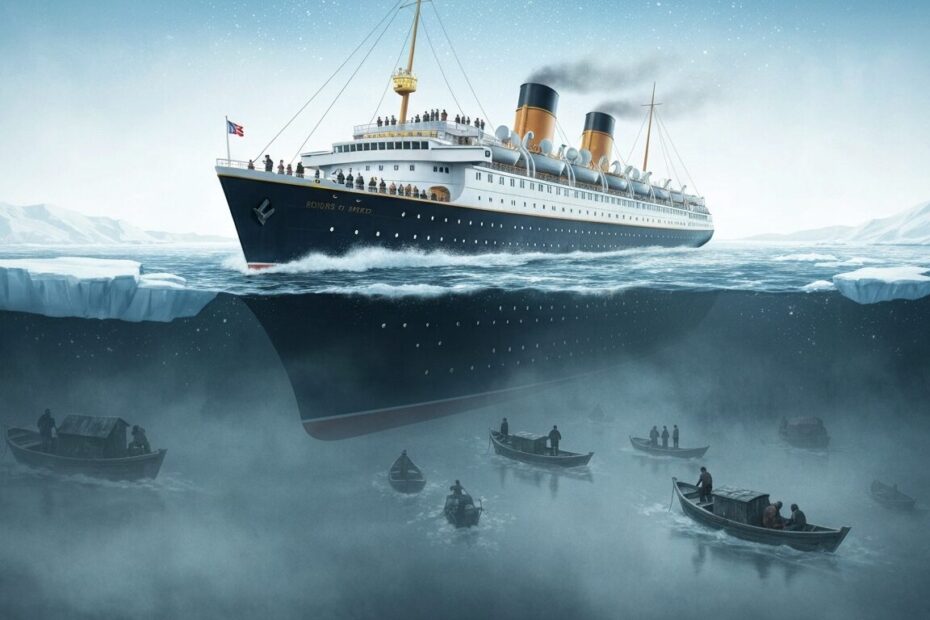
Personally, seeing economic inequality rise suggests we must prioritize fairer systems.#economics #inequality
Quick Video Breakdown: This Blog Article
This video clearly explains this blog article.
Even if you don’t have time to read the text, you can quickly grasp the key points through this video. Please check it out!
If you find this video helpful, please follow the YouTube channel “LifeNextDaily,” which delivers daily news.
https://www.youtube.com/@LifeNextDaily
Read this article in your native language (10+ supported) 👉
[Read in your language]
Titanic Inequality: When the Economic Ship Hits the Iceberg of Disparity
⚠️ WARNING: Technology and investments involve risks. This is not financial advice. DYOR (Do Your Own Research).
High-Impact Intro
John: 👋 Hey, fellow navigators of the economic seas! Imagine the Titanic: a majestic vessel where the elite sipped champagne in first-class lounges while the steerage passengers below deck fought for scraps. Fast-forward to 2025, and that metaphor isn’t just a Hollywood blockbuster—it’s our global economy on steroids. With reports like the World Inequality Report 2026 screaming “Inequality persists at a very extreme level,” it’s time to dissect this beast. Why now? Because in a post-pandemic world, the K-shaped recovery has the rich soaring like eagles (or first-class passengers in lifeboats) while the rest tread water. Analysts from Brookings and The Guardian highlight that just 0.001% hold three times the wealth of the poorest half of humanity. Buckle up—we’re diving into the witty, watery depths of economic disparity, armed with analogies and data, but remember, this is education, not a treasure map.
Lila: John, you’re channeling your inner Leo DiCaprio there. For beginners, think of it like a family pizza night where one sibling hogs all the slices—frustrating, right? But seriously, this matters in 2025 because rising inequality isn’t just unfair; research suggests it can drag down overall growth, mental health, and even work hours, as per recent studies from Nature and PsyPost.
The Problem (The “Why”)
John: Let’s roast the hype first: Economic inequality isn’t some new villain; it’s been lurking since the Industrial Revolution. But in 2025, it’s titanic—pun intended. The “old way” was assuming growth lifts all boats, like a rising tide. Spoiler: It doesn’t. Instead, we have a K-shaped economy, where the upper arm skyrockets (think tech moguls and stock portfolios) and the lower arm plummets (wage stagnation, gig jobs).
Analogy time: Picture a video game where the top players hoard all the power-ups, leaving newbies grinding levels with rusty gear. In the real world, this bottleneck means the bottom 50% of American households hold just a fraction of total wealth—averaging a measly $180,000 per household for the bottom 20%, per Red94.net reports. The old way was risky because it relied on trickle-down myths, ignoring how disparity fuels social unrest, longer work hours for the disadvantaged (as PsyPost notes), and even environmental strain, according to Nature Sustainability.
Lila: Exactly, John. For intermediates, consider the psychological toll: Living in high-inequality spots doesn’t directly tank well-being, per Nature’s meta-analysis of 11 million people, but it amplifies stress from chasing the Joneses. The hard part? It’s expensive—policy inaction costs societies in lost productivity and health burdens.
Under the Hood: How it Works

John: Alright, let’s break this down like disassembling a faulty engine. Economic inequality isn’t random; it’s a mechanism driven by factors like income distribution, wealth accumulation, and policy levers. Step 1: Income gaps widen when top earners (the top 10%) capture more than the bottom 90%, as The Guardian reports. This happens via capital gains, executive pay, and tech-driven productivity that benefits owners over workers.
Step 2: Wealth compounds—like interest on a snowballing debt, but for the rich. The richest 10% own three-quarters of global personal wealth, per Al Jazeera. Analogy: It’s like a Monopoly game where early property grabs let you build hotels while others pay rent forever.
Step 3: Socioeconomic implications kick in. Rising inequality predicts longer work hours globally, especially for disadvantaged groups, as PsyPost’s analysis shows. Policies? Think tax structures or education access—the IMF notes that within-country inequality has risen in advanced economies, hurting long-term growth.
Lila: For beginners, imagine your paycheck as a pie: In unequal systems, the biggest slice goes to the chef, not the waitstaff. Intermediates, dive into the Gini coefficient—South Africa’s is sky-high, per Taylor & Francis studies, linking it to sluggish growth.
| Aspect | Old Way (Trickle-Down Economics) | New Perspective (Inequality-Focused Analysis) |
|---|---|---|
| Wealth Distribution | Assumes benefits flow down naturally | Recognizes hoarding at the top; top 0.001% hold 3x poorest half’s wealth |
| Economic Growth Impact | Growth for all via GDP rise | Inequality hampers sustained growth; IMF suggests design policies to tackle it |
| Work and Well-Being | No direct link to inequality | Leads to longer hours and socioecological strain, per Nature studies |
| Policy Focus | Deregulation and tax cuts for the wealthy | Progressive taxes and inclusive growth strategies |
Practical Use Cases & Application
John: So, how does understanding Titanic Inequality change your daily grind? Let’s get concrete. Use case 1: In personal finance, it sharpens your lens on investments. One perspective is diversifying beyond stocks that favor the elite—think about how inequality boosts volatility in markets. For example, if you’re a mid-level worker, recognizing the K-shaped economy might prompt you to build emergency funds amid wage gaps.
Use case 2: Career decisions. With inequality pushing longer hours (PsyPost), consider gig economy pitfalls versus stable sectors. Analogy: Don’t be the steerage passenger; aim for skills that bridge the divide, like tech literacy.
Use case 3: Policy awareness. In voting or advocacy, grasp how extreme disparity (World Inequality Database) affects public services—lobby for fair taxes without expecting miracles.
Use case 4: Global view. For travelers or expats, note where inequality is worst (Al Jazeera lists) to inform relocation—high-disparity spots might mean higher costs for basics.
Lila: Spot on. For beginners, it’s like checking the weather before sailing—inequality forecasts economic storms. Intermediates, model your budget against reports like Pew Research’s global challenges.
Educational Action Plan (How to Start)
John: No hype, just steps. Level 1 (Learn): Start with the World Inequality Report 2026 at wid.world—it’s free and data-packed. Watch Brookings’ 2025 recap for visuals. Check IMF’s inequality page for basics.
Level 2 (Try Safely): Analyze your own finances safely—track income vs. expenses using free spreadsheets. Simulate scenarios: If inequality rises, how might it affect your job sector? Research suggests discussing with peers or joining non-investment forums for perspectives. Emphasize small-scale learning: Read one article weekly, like The Guardian’s on wealth gaps, and note risks like misinformation.
Lila: Remember, this is educational—consider risks like overanalyzing leading to stress.
Conclusion & Future Outlook
John: In summary, Titanic Inequality’s risks (social unrest, growth drags) versus rewards (awareness drives better policies) highlight effort in education yielding gains in informed decisions. Uncertainty looms—2026 projections from Deloitte suggest persisting divides, so watch for policy shifts. One interpretation: Sustainable growth needs addressing this iceberg.
Lila: Stay curious, folks—knowledge is your lifeboat.

👨💻 Author: SnowJon (Web3 & AI Practitioner / Investor)
A researcher who leverages knowledge gained from the University of Tokyo Blockchain Innovation Program to share practical insights on Web3 and AI technologies.
His motto is to translate complex technologies into forms that anyone can evaluate and use responsibly, fusing academic knowledge with practical experience.
*AI may assist drafting and structuring, but final verification and responsibility remain with the human author.
References
- Titanic Inequality
- World Inequality Report 2026 – World Inequality Database
- Just 0.001% hold three times the wealth of poorest half of humanity – The Guardian
- Income Inequality – IMF
- Economic Inequality Seen as Major Challenge Around the World – Pew Research Center
- A look back at 2025—and what’s in store for 2026—from the Global Economy and Development program – Brookings