
Read this article in your native language (10+ supported) 👉
[Read in your language]
This Everyday Disruption Was Linked To A 50% Higher Dementia Risk
⚠️ DISCLAIMER: This article is for informational purposes only and does not constitute medical advice. Always consult a healthcare professional.
John: 👋 Hello, Health Hackers! Imagine your brain as a high-performance engine—tune it wrong, and it sputters out early. A recent study spotlighted how one sneaky daily disruptor, irregular daily routines, cranks up dementia risk by up to 50%. We’re talking chaos in your sleep-wake cycle, erratic meal times, and that “winging it” lifestyle that feels free but might be silently aging your brain. Why now? In 2026, with longer lifespans, dementia cases are exploding—research shows lifestyle tweaks could slash risks, yet most folks ignore the basics. This isn’t hype; it’s data from brain scans and long-term cohorts linking routine stability to sharper cognition into your 80s.
Lila: John, that stat sounds scary. Is it really 50% higher risk from something everyday?
John: Spot on, Lila—studies tie social jet lag (your weekend sleep shifts) and inconsistent schedules to inflammation and faster brain atrophy, bumping dementia odds significantly. But it’s not doom; consistent rhythms protect like a fortress.
John: Quick self-check: Which one are you? The skeptical night owl who thrives on chaos? The overwhelmed parent juggling irregular shifts? The curious desk jockey eyeing brain longevity? Or the time-poor hustler surviving on coffee and catch-up sleep?
The Problem (The “Why”)
Lila: Okay, break it down like I’m five. Why does an irregular day wreck my brain?
John: Think of your circadian rhythm as a garden’s watering schedule. Water at dawn daily, and plants thrive—drench at midnight randomly, and roots rot. Irregular routines (late nights, skipped breakfasts, weekend lie-ins) create “social jet lag,” mimicking constant time-zone hops. This spikes cortisol, inflammation, and blood sugar chaos, accelerating brain shrinkage starting at 30. Old way? Humans evolved for hunter-gatherer consistency; modern life hacks that with 24/7 screens and shift work, hiking dementia risk via amyloid buildup and poor myelin repair.
Lila: What’s the hard part or risk in fixing it?
John: It’s expensive in effort upfront—rewiring habits feels like herding cats—but risks of ignoring? Faster cognitive aging, mood dips, even metabolic mess linking to diabetes, a 60% dementia booster.
John: Myth vs Reality: Myth: “Sleep when you’re dead—consistency is boring.” Reality: Research shows irregular sleep ages brain structure faster, targeting vulnerable spots like the hippocampus. Takeaway: Anchor one ritual, like dinner at 7 PM, for quick wins.
Under the Hood: How it Works
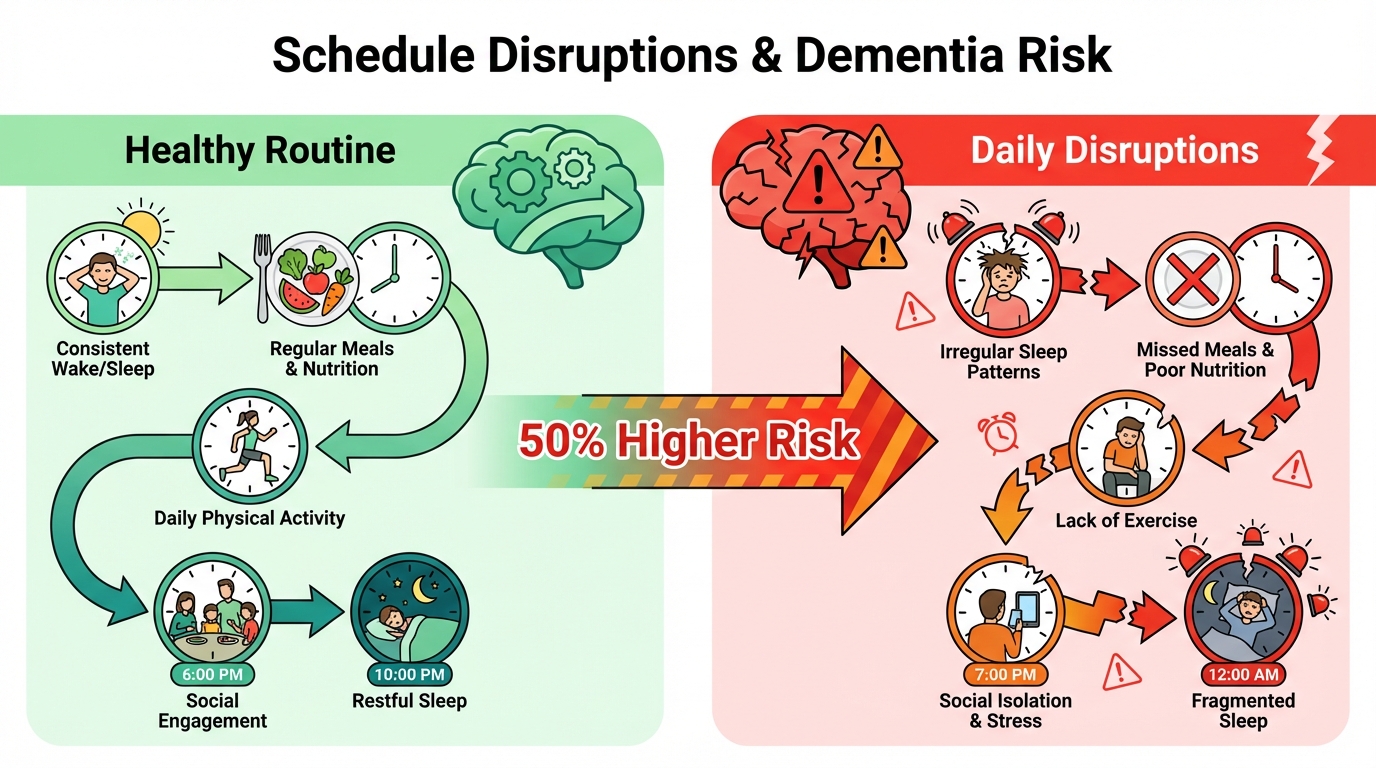
Lila: That diagram looks like a clock fighting zombies. Explain the mechanism simply.
John: Your body’s master clock, the suprachiasmatic nucleus in the hypothalamus, syncs via light, meals, and motion. Irregularity desyncs it, like a drummer off-beat, triggering:
1. **Hormonal havoc:** Melatonin delayed, cortisol floods—eroding brain cells.
2. **Neuroinflammation:** Gut-brain axis glitches, amyloid plaques form (Alzheimer’s hallmark).
3. **White matter wear:** Myelin (insulation on brain wires) thins, slowing thoughts.
Beginner steps: Sunlight at wake-up cues the clock; steady meals fuel it; evening wind-down seals it.
John: One Diagram, Three Layers:
– **Layer 1: 10 seconds**—Irregular days = brain jet lag → inflammation → dementia risk up 50%.
– **Layer 2: 60 seconds**—Light hits eyes → pineal gland melatonin → sleep repair mode. Disrupt? Chronic stress → hippocampal shrink → memory fail.
– **Layer 3: 3 minutes**—Assumptions: Works best pre-65; limits: Genetics override 20%; failures: Shift workers adapt poorly without countermeasures like naps.
| Old Way (Irregular Chaos) | New Way (Routine Rhythm) |
|---|---|
| Weekend sleep-in → social jet lag → 50% higher dementia odds | Same wake time daily → stable clock → brain age drops months per habit |
| Random meals → blood sugar spikes → inflammation | Fixed eat times → steady energy → myelin protection |
| Screen till midnight → melatonin block → atrophy | Blue-light curfew → deep sleep → neuron growth |
Practical Use Cases & Application
Lila: How does this play out in real life?
John: Scenario 1: Office warrior—set 7 AM alarm, breakfast at 8, walk post-lunch. Brain fog lifts; decisions sharpen. Scenario 2: Parent chaos—anchor kid bedtime routine as yours; consistent dinner rebuilds rhythm. Scenario 3: Freelancer flux—block “golden hours” 9-5 for deep work, no all-nighters. Changes? Wake refreshed, recall names easier, stress drops. Scenario 4: Retiree—mimic workday structure; mornings active, afternoons social—staves off decline.
Lila: But what if my job demands odd hours?
John: Research suggests “anchor sleep” mid-shift plus naps; track via journal to minimize drift.
Lila: Does movement or diet amplify this?
John: Yes—even light daily moves reverse 4 years cognitive age; pair with routine for synergy.
Educational Action Plan (How to Start)
John: Level 1 (Learn): Read circadian basics from NIH or Oxford studies; track your week—noting wake/eat/sleep.
Lila: Safe trials?
John: Level 2 (Try Safely): Shift bedtime 15 mins earlier nightly; dim lights post-8 PM. Small, measurable.
John: Tiny Experiment (15 minutes today): Goal: Test rhythm reset. Steps: 1) Now, stand in sunlight 5 mins. 2) Plan tomorrow’s wake/meal anchors. 3) Evening: No screens 30 mins pre-bed. Observe: Energy tomorrow vs today. Low-risk, eye-opening.
Conclusion & Future Outlook
Lila: Tradeoffs?
John: Effort: 2 weeks habit grind. Gain: Slower aging, better mood. Uncertainty: Individual variance; watch biomarkers.
John: Risk Ledger:
- What can go wrong? Over-rigid routines breed burnout; ignore genetics.
- Who should be careful? Shift workers, insomniacs—ease in slow.
- Safest minimum: One daily anchor (e.g., coffee at 8 AM).
John: What to Watch Next:
- Monitor: Sleep quality via journal—deeper = winning.
- Controversy: How much blue light truly disrupts vs hype?
- Skill to build: Habit stacking for unbreakable routines.
References
- This Everyday Disruption Was Linked To A 50% Higher Dementia Risk
- Study Confirms 3 Habits That Age Your Brain Faster
- Your Brain Starts To Shrink At Age 30 — Here’s What To Do About It
- Research Shows This Daily Habit Is Linked To Lower Dementia Risk
- NIH on Brain Aging
- Alzheimer’s Society: Reduce Dementia Risk
▼ AI tools to streamline research and content production (free tiers may be available)
Free AI search & fact-checking
👉 Genspark
Recommended use: Quickly verify key claims and track down primary sources before publishing
Ultra-fast slides & pitch decks (free trial may be available)
👉 Gamma
Recommended use: Turn your article outline into a clean slide deck for sharing and repurposing
Auto-convert trending articles into short-form videos (free trial may be available)
👉 Revid.ai
Recommended use: Generate short-video scripts and visuals from your headline/section structure
Faceless explainer video generation (free creation may be available)
👉 Nolang
Recommended use: Create narrated explainer videos from bullet points or simple diagrams
Full task automation (start from a free plan)
👉 Make.com
Recommended use: Automate your workflow from publishing → social posting → logging → next-task creation
※Links may include affiliate tracking, and free tiers/features can change; please check each official site for the latest details.