
Unlock your child’s future! LA schools are launching Portuguese programs, boosting cognitive skills & opening global doors. See how.#LAPortuguese #LanguageLearning #GlobalEd
Quick Video Breakdown: This Blog Article
This video clearly explains this blog article.
Even if you don’t have time to read the text, you can quickly grasp the key points through this video. Please check it out!
If you find this video helpful, please follow the YouTube channel “LifeNextDaily,” which delivers daily news.
https://www.youtube.com/@LifeNextDaily
Read this article in your native language (10+ supported) 👉
[Read in your language]
Los Angeles Schools Sign Portuguese Deal
⚠️ WARNING: Technology and investments involve risks. This is not financial advice. DYOR (Do Your Own Research).
John: 👋 Hey, Language Learners and Global Thinkers! Imagine if your local school suddenly opened a door to a whole new world—not through some sci-fi portal, but by inking a deal that brings Portuguese into classrooms. That’s exactly what’s happening in Los Angeles, where the schools have just signed a groundbreaking agreement to promote Portuguese language education. Why does this matter now? Well, in a city as diverse as LA, with immigration debates raging and enrollment dips due to recent policies (think those Trump-era raids still echoing), this move isn’t just about adding a language; it’s about building bridges, boosting cultural literacy, and preparing kids for a hyper-connected future. According to recent reports, the Los Angeles Unified School District (LAUSD) has partnered with Portugal’s Camões Institute to introduce Portuguese programs, marking their first-ever such memorandum. It’s timely—amid literacy grants pouring in nationwide and global strikes in Portugal highlighting labor reforms, this deal underscores education’s role in fostering international ties. But hey, don’t take my word for it; this is cutting through the fluff to see how language learning can supercharge personal and professional growth.
Lila: Totally, John. For beginners dipping their toes into self-growth, this news is a reminder that learning a new language isn’t just a hobby—it’s a productivity hack. Research suggests multilingualism can enhance cognitive flexibility, much like weight training for your brain. And in 2025, with AI translation tools everywhere, why bother? Because human connection beats machine precision every time. Stop endless scrolling through language apps reviews. Ask Genspark to summarize the facts for you on the best ways to start Portuguese today.
The Problem (The “Why”)
John: Let’s roast the hype first: We’ve all heard the “learn a language in 30 days” scams that promise fluency faster than you can say “obrigado.” But the real bottleneck? Our education systems often treat languages as electives, not essentials, leaving students monolingual in a multilingual world. Think of it like trying to navigate a bustling international airport with only a toy map—frustrating, limiting, and prone to missed opportunities. In LA, enrollment is plummeting due to immigration fears, as per recent LA Times reports, and that’s compounded by a lack of engaging, culturally relevant programs. The economic angle? Portuguese is spoken by over 260 million people, opening doors to Brazil’s booming economy and Portugal’s tech scene. Without this, we’re stuck in echo chambers, missing out on global collaboration.
Lila: Analogy time: It’s like cooking with only salt and pepper—your meals are bland. Adding Portuguese is like tossing in exotic spices, transforming the flavor. For intermediate folks, this deal addresses the psychological hurdle of “language anxiety,” where fear of mistakes halts progress. Need to explain this concept to your team or family? Use Gamma to generate a visual presentation in seconds, mapping out how cultural immersion beats rote memorization.
Under the Hood: How it Works
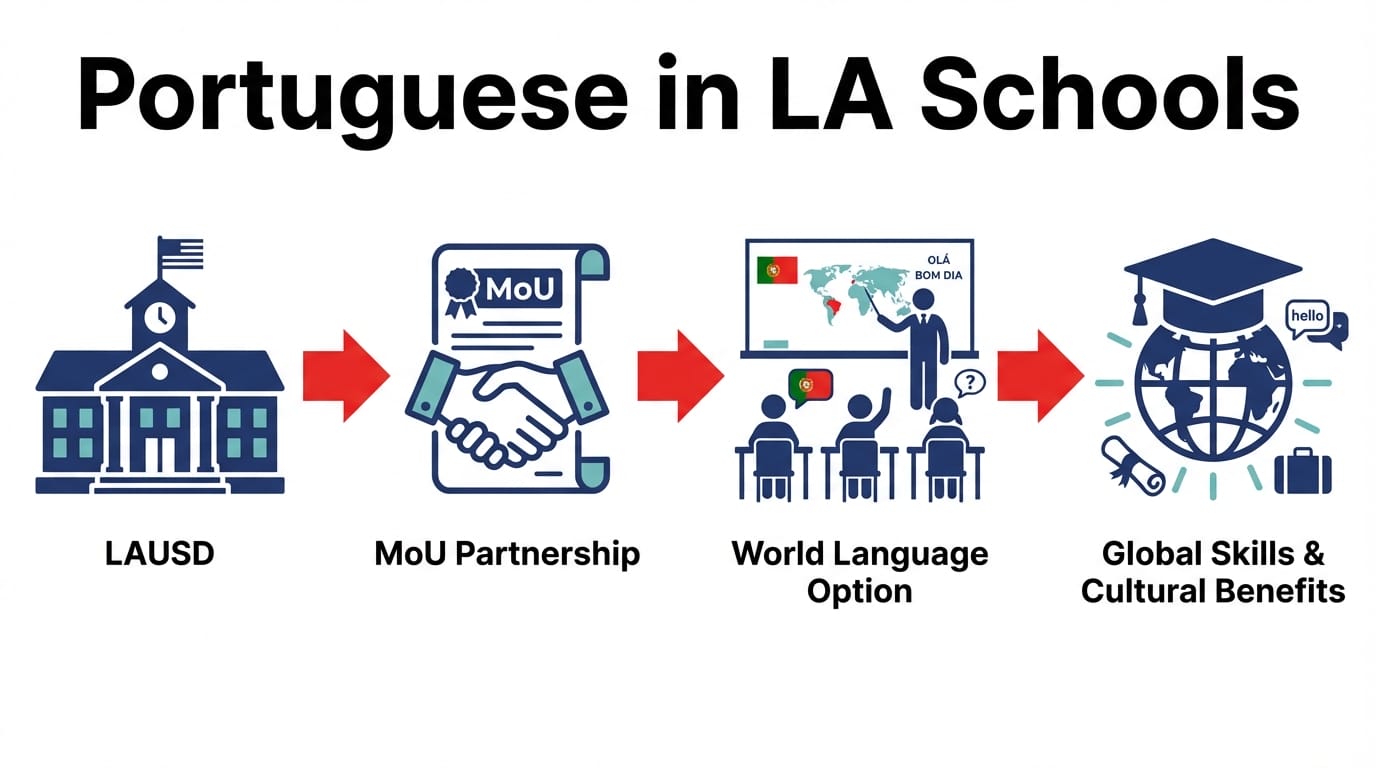
John: Diving deep: This deal, as detailed in Language Magazine’s December 13, 2025, article, is a memorandum of understanding (MoU) between LAUSD and the Camões Institute. It introduces Portuguese curricula into public schools, starting with pilot programs that integrate language with cultural studies. The mechanism? It’s not just grammar drills; it’s immersive, using tech like AI-assisted apps and virtual exchanges with Portuguese speakers. Scientifically, language acquisition relies on neuroplasticity—your brain’s ability to rewire itself. Studies from hubs like Huberman Lab suggest consistent exposure builds neural pathways, much like Atomic Habits’ compounding effect. In LA, Superintendent Alberto Carvalho, fresh off a contract renewal, is pushing this amid $256 million in literacy grants from the U.S. Department of Education. The “old way” was siloed learning; the new way embeds languages in core education, fostering empathy and economic savvy.
Lila: Breaking it down for beginners: Imagine your brain as a garden. Monolingualism is a single flower; adding Portuguese plants a vibrant vine that connects everything. For intermediates, let’s compare approaches.
| Aspect | Traditional Language Learning | LAUSD Portuguese Deal Approach |
|---|---|---|
| Focus | Grammar and vocabulary drills | Cultural immersion and real-world application |
| Accessibility | Limited to electives or apps | Integrated into public school curriculum |
| Outcomes | Basic conversational skills | Cognitive boosts and global opportunities |
| Challenges | High dropout rates due to boredom | Overcomes with partnerships and funding |
Practical Use Cases & Application
John: How does this change daily life? For students in LA, it means classes that connect to real-world scenarios—like virtual field trips to Lisbon or collaborations with Brazilian entrepreneurs. Parents get child-care relief through extended programs, echoing LAUSD’s extra learning days. Professionally, Portuguese unlocks markets in emerging economies; think tech jobs in Lisbon’s startup scene or trade with Brazil’s agriculture giants. One perspective is that in a post-COVID world, multilingualism is a resilience tool, helping navigate global disruptions like Portugal’s recent strikes.
Lila: Witty take: It’s like upgrading from a flip phone to a smartphone—suddenly, the world is at your fingertips. Want to share this insight on TikTok/Shorts? Turn this article into a viral video using Revid.ai. For intermediates, apply it by joining online communities or using apps like Duolingo with a cultural twist.
Educational Action Plan (How to Start)
John: Let’s get actionable. Level 1 (Learn): Dive into basics—read “The Portuguese: A Modern History” or check Language Magazine’s coverage for context. Study symptoms of “monolingual mindset” like cultural blind spots. Use tools like Notion to track progress.
Lila: Level 2 (Act): Start small habits—10 minutes daily on apps, then test “immersion trials” like Portuguese podcasts. Too much text? Let Nolang explain this document to you in a video summary. Build up to conversations via language exchanges.
Conclusion & Future Outlook
John: Summing up: Risks include implementation hiccups amid LA’s enrollment woes, but rewards? Enhanced cognition, career edges, and cultural richness. Effort vs. gain tilts positive with sustainable habits. Future-wise, expect more such deals as education globalizes—perhaps AI tutors amplifying this.
Lila: Smart people automate. Whether it’s health logs or price alerts, set up workflows with Make.com to save time on your language learning journey.
🛑 General Disclaimer
This article is for educational purposes only. I am not a doctor or financial advisor. Information regarding health, investments, or law should be verified with professionals. DYOR and take responsibility for your own decisions.
🛠️ Tools Mentioned: