In my view simple movement is a powerful tool for aiding cancer recovery journeys#CancerRecovery #Health
Quick Video Breakdown: This Blog Article
This video clearly explains this blog article.
Even if you don’t have time to read the text, you can quickly grasp the key points through this video. Please check it out!
If you find this video helpful, please follow the YouTube channel “LifeNextDaily,” which delivers daily news.
https://www.youtube.com/@LifeNextDaily
Read this article in your native language (10+ supported) 👉
[Read in your language]
This Lifestyle Shift Dramatically Improves Cancer Outcomes (& It’s Free)
⚠️ DISCLAIMER: This article is for informational purposes only and does not constitute medical advice. Always consult a healthcare professional.
John: 👋 Hello, Health Hackers! If you’ve ever thought that beating cancer is all about high-tech treatments and pricey meds, buckle up—because research is flipping the script with something as simple (and free) as moving your body. Today, we’re diving into how exercise is emerging as a game-changer in cancer outcomes, based on insights from mindbodygreen.com. It’s witty how something we’ve known helps with weight and mood is now a frontline ally against one of humanity’s toughest foes.
Lila: Wait, John, exercise for cancer? Isn’t rest the priority during treatment? Why is this blowing up now?
John: Great question, Lila. The buzz is timely because organizations like the American Society of Clinical Oncology (ASCO) have recently endorsed exercise as part of cancer care guidelines. Picture this: In a world where cancer affects over 18 million people globally each year (per WHO stats), studies show that regular physical activity can slash recurrence risks by up to 30-40% for certain cancers like breast and colon. It’s free, accessible, and backed by science—not some trendy fad. Why now? Post-pandemic, we’re seeing a surge in holistic health research, with trials proving exercise boosts survival rates without the side effects of drugs. But remember, this isn’t a cure-all; it’s a complementary shift that empowers patients. Let’s unpack why the old “rest-only” approach is outdated and how this lifestyle tweak can make a real difference.
Lila: Okay, that hooks me. But for beginners, what’s the big problem it’s solving?
The Problem (The “Why”)
John: Alright, let’s roast the old myths. Traditionally, cancer treatment meant hunkering down—chemo, radiation, surgery, and lots of bed rest. The thinking was: Your body’s fighting a war, so conserve energy. But here’s the bottleneck: Inactivity leads to muscle loss, fatigue, and even weakened immunity, making recovery harder. It’s like leaving your car in the garage during winter; it doesn’t just sit there—it rusts, the battery dies, and starting it up again is a nightmare.
Lila: Analogy game strong! So, the “old way” was expensive in terms of lost quality of life, right? Physically, patients dealt with deconditioning, where muscles atrophy up to 1% per day of bed rest, per studies in the Journal of Applied Physiology. Psychologically, isolation and inactivity spike depression risks. Economically, longer recoveries mean more hospital stays and lost work—costing societies billions. Research suggests this sedentary trap can worsen outcomes, with inactive patients facing higher mortality rates.
John: Exactly. The “why” boils down to biology: Cancer thrives in inflamed, low-oxygen environments, and sitting around exacerbates that. It’s risky because it creates a vicious cycle—treatment zaps energy, leading to more rest, which zaps more energy. Breaking this with movement? That’s the shift we’re talking about.
The Science Behind It
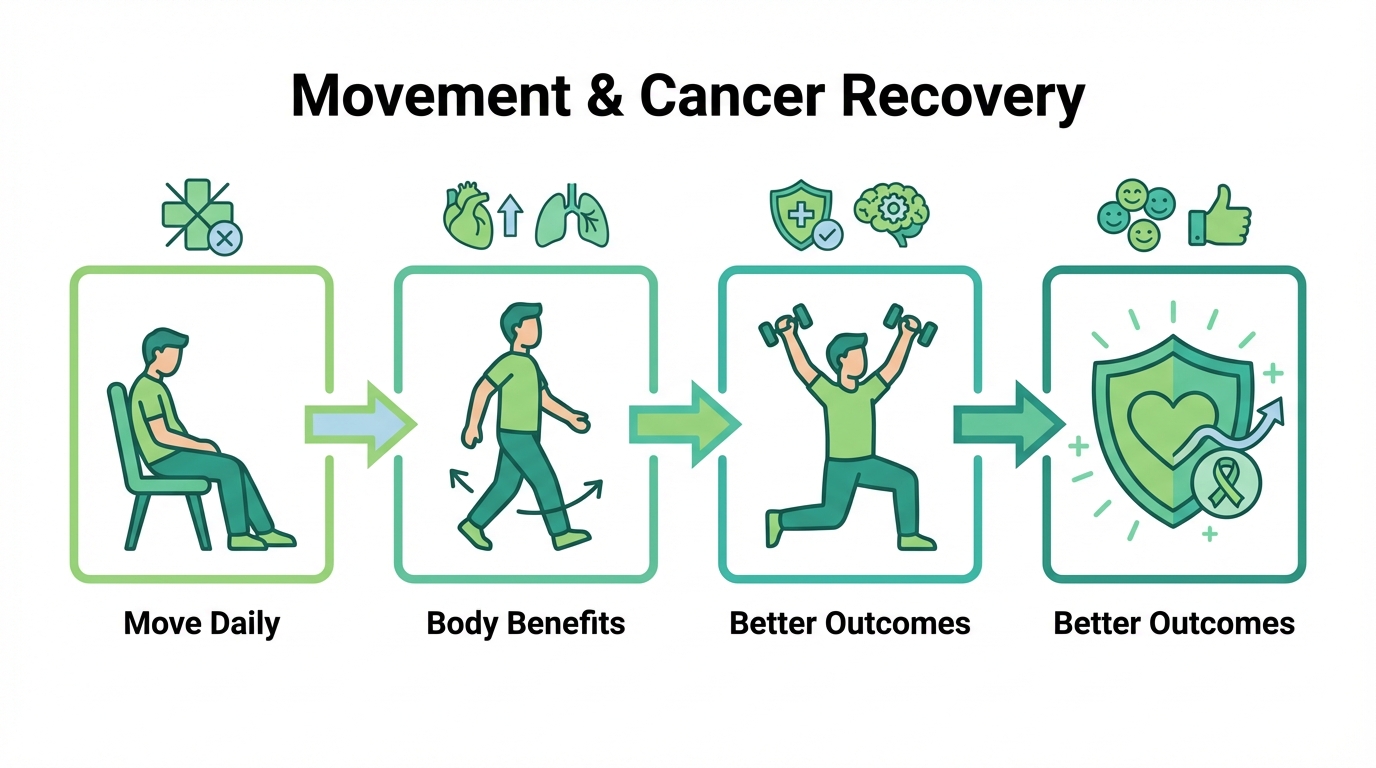
John: Under the hood, exercise works its magic on multiple fronts. Let’s break it down beginner-style, like tuning up a rusty engine.
Lila: Step 1?
John: First, it boosts circulation. Movement pumps blood richer in oxygen and nutrients to tissues, starving cancer cells that prefer low-oxygen spots. Studies from the National Cancer Institute show this can reduce tumor growth.
Lila: Step 2: Immunity?
John: Spot on. Exercise ramps up natural killer cells—your body’s hit squad against rogue cells. A meta-analysis in the British Journal of Sports Medicine found that moderate activity increases these by up to 50% post-session.
Lila: And inflammation?
John: Step 3: It dials down chronic inflammation via myokines—proteins released by muscles that act like anti-inflammatory superheroes. This is huge, as inflammation fuels cancer progression.
Lila: Last one: Mental side?
John: Exercise releases endorphins, slashing stress hormones like cortisol that can suppress immunity. Plus, it preserves muscle mass, fighting cachexia (wasting syndrome) common in cancer.
Lila: Witty note: It’s like upgrading from a rusty bike to a turbo-charged one—free fuel included!
John: To compare, here’s a table breaking down the old vs. new approaches:
| Aspect | Old Way (Rest-Only) | New Way (Exercise-Integrated) |
|---|---|---|
| Physical Impact | Muscle loss, fatigue, higher recurrence risk | Preserved strength, better energy, up to 40% lower recurrence |
| Mental Health | Increased depression and anxiety from inactivity | Endorphin boost, reduced stress, improved mood |
| Cost | Higher medical bills from prolonged recovery | Free or low-cost, potentially shorter hospital stays |
| Risks | Deconditioning, weakened immunity | Overexertion if not monitored, but manageable with guidance |
John: See? The new way isn’t about extremes—it’s balanced, evidence-based, and empowering.
Practical Use Cases & Application
Lila: How does this play out in real life for someone facing cancer?
John: Let’s get concrete. Research suggests this shift changes daily life by integrating movement safely, always under medical supervision.
Lila: Example 1: During treatment?
John: For a breast cancer patient undergoing chemo, light walking or yoga (15-30 minutes daily) can reduce nausea and fatigue. One perspective is it helps maintain routine, turning “sick days” into manageable ones—studies show improved treatment tolerance.
Lila: Example 2: Post-recovery?
John: A colon cancer survivor might incorporate strength training to rebuild muscle. This changes work life by boosting energy for returning to jobs, with data indicating lower disability rates.
Lila: Example 3: Prevention angle?
John: For high-risk individuals, regular cardio could lower incidence by enhancing metabolic health. Daily decisions shift—like choosing stairs over elevators—fostering long-term habits.
Lila: Example 4: Mental boost in survivorship?
John: Group activities like swimming classes build community, aiding emotional recovery. It reframes decision-making from fear-based to proactive, with balanced risks like starting slow to avoid injury.
John: Humor break: It’s like turning your body from a couch potato into a stealth ninja—sneaking past cancer’s defenses!
Educational Action Plan (How to Start)
Lila: For beginners, how do we dip our toes in responsibly?
John: Keep it educational and safe—no one-size-fits-all. Research suggests starting with knowledge, then small steps.
Lila: Level 1: Learn.
John: Begin by reading reputable sources like the American Cancer Society’s guidelines on physical activity. Watch free videos from NIH on exercise benefits. Check studies in journals like The Lancet Oncology to understand evidence. One perspective: Track key stats, like how 150 minutes of moderate activity weekly is a benchmark.
Lila: Level 2: Try Safely.
John: Always consult your doctor first for personalized clearance. Start small: Try 10-minute walks, monitoring how you feel. Use home-based demos like chair yoga from credible sites. Emphasize safety—consider risks like fatigue, and scale up gradually. For example, log sessions in a journal to see patterns, but remember, results vary.
John: Witty tip: Think of it as leveling up in a video game—unlock health bonuses without the cheat codes.
Conclusion & Future Outlook
Lila: Wrapping up, John—what’s the takeaway?
John: This lifestyle shift offers big rewards—like better outcomes and quality of life—with minimal effort compared to inaction’s risks (e.g., higher recurrence). But uncertainty lingers: Not all cancers respond equally, and more long-term studies are needed. Watch for evolving guidelines from ASCO and emerging research on personalized exercise plans. Research suggests the future could integrate AI for tailored routines, but always prioritize professional advice. Effort vs. gain? High return if done right—empowering and free.
Lila: Thanks for the objective deep dive—stay moving, folks!

👨💻 Author: SnowJon (Web3 & AI Practitioner / Investor)
A researcher who leverages knowledge gained from the University of Tokyo Blockchain Innovation Program to share practical insights on Web3 and AI technologies.
His motto is to translate complex technologies into forms that anyone can evaluate and use responsibly, fusing academic knowledge with practical experience.
*AI may assist drafting and structuring, but final verification and responsibility remain with the human author.
References
- This Lifestyle Shift Dramatically Improves Cancer Outcomes (& It’s Free)
- American Cancer Society Guidelines on Nutrition and Physical Activity for Cancer Prevention
- Exercise in Regulation of Inflammation-immune Axis Function in Cancer (NIH Study)
- Cancer Survivors: Care for Your Body After Treatment (Mayo Clinic)
- Exercise Guidelines for Cancer Survivors (ASCO Journal)
▼ AI tools to streamline research and content production (free tiers may be available)
Free AI search & fact-checking
👉 Genspark
Recommended use: Quickly verify key claims and track down primary sources before publishing
Ultra-fast slides & pitch decks (free trial may be available)
👉 Gamma
Recommended use: Turn your article outline into a clean slide deck for sharing and repurposing
Auto-convert trending articles into short-form videos (free trial may be available)
👉 Revid.ai
Recommended use: Generate short-video scripts and visuals from your headline/section structure
Faceless explainer video generation (free creation may be available)
👉 Nolang
Recommended use: Create narrated explainer videos from bullet points or simple diagrams
Full task automation (start from a free plan)
👉 Make.com
Recommended use: Automate your workflow from publishing → social posting → logging → next-task creation
※Links may include affiliate tracking, and free tiers/features can change; please check each official site for the latest details.