Personally, a solid literacy framework creates lifelong clarity.#education #literacy
Quick Video Breakdown: This Blog Article
This video clearly explains this blog article.
Even if you don’t have time to read the text, you can quickly grasp the key points through this video. Please check it out!
If you find this video helpful, please follow the YouTube channel “LifeNextDaily,” which delivers daily news.
https://www.youtube.com/@LifeNextDaily
Read this article in your native language (10+ supported) 👉
[Read in your language]
Building a Literacy Framework That Works: A Witty Guide to Word Wizardry
⚠️ DISCLAIMER: This article is for informational purposes only. Results vary. Always consult educational experts for personalized advice.
High-Impact Intro
👋 Hello, Word Wizards and Aspiring Linguists! Imagine if reading wasn’t just a chore but a superpower—unlocking doors to new worlds, sharper thinking, and even better career prospects. In a world where information overload is the norm, building a solid literacy framework isn’t just nice-to-have; it’s essential for thriving in 2026 and beyond.
Why does this matter now? With the rise of digital media, misinformation, and AI-generated content, strong literacy skills are your best defense. According to recent studies, over 50% of adults in developed countries struggle with advanced literacy tasks, leading to gaps in critical thinking and economic opportunities. The blog post from Language Magazine highlights a fresh approach to literacy education that’s practical, evidence-based, and—dare we say—fun. We’re diving into how to build a framework that actually works, blending humor, analogies, and real-talk to make it stick. Buckle up; by the end, you’ll be ready to level up your literacy game without the eye rolls.
The Problem (The “Why”)
Let’s kick things off with a real-world analogy: Think of traditional literacy education like trying to cook a gourmet meal using only a microwave and expired ingredients. It’s hasty, inconsistent, and often leaves you with a half-baked result—maybe you can read the words, but do you really get the flavor? The “old way” of teaching literacy often relies on rote memorization, endless drills, and one-size-fits-all methods that ignore individual learning styles. This leads to frustration, high dropout rates in reading programs, and adults who can skim a text but can’t analyze or apply it.
What was hard, expensive, or risky before? For starters, it was time-intensive—teachers spending hours on phonics without connecting to real-life comprehension. It was expensive in terms of resources, with schools pouring money into outdated textbooks that gather dust. And risky? Absolutely: Kids who fall behind early often face lifelong challenges, from lower job prospects to vulnerability to fake news. Research suggests that without a structured framework, literacy gaps widen, affecting everything from personal growth to societal progress. It’s like building a house on sand—looks okay at first, but one storm (hello, complex modern texts) and it crumbles.
The Science Behind It
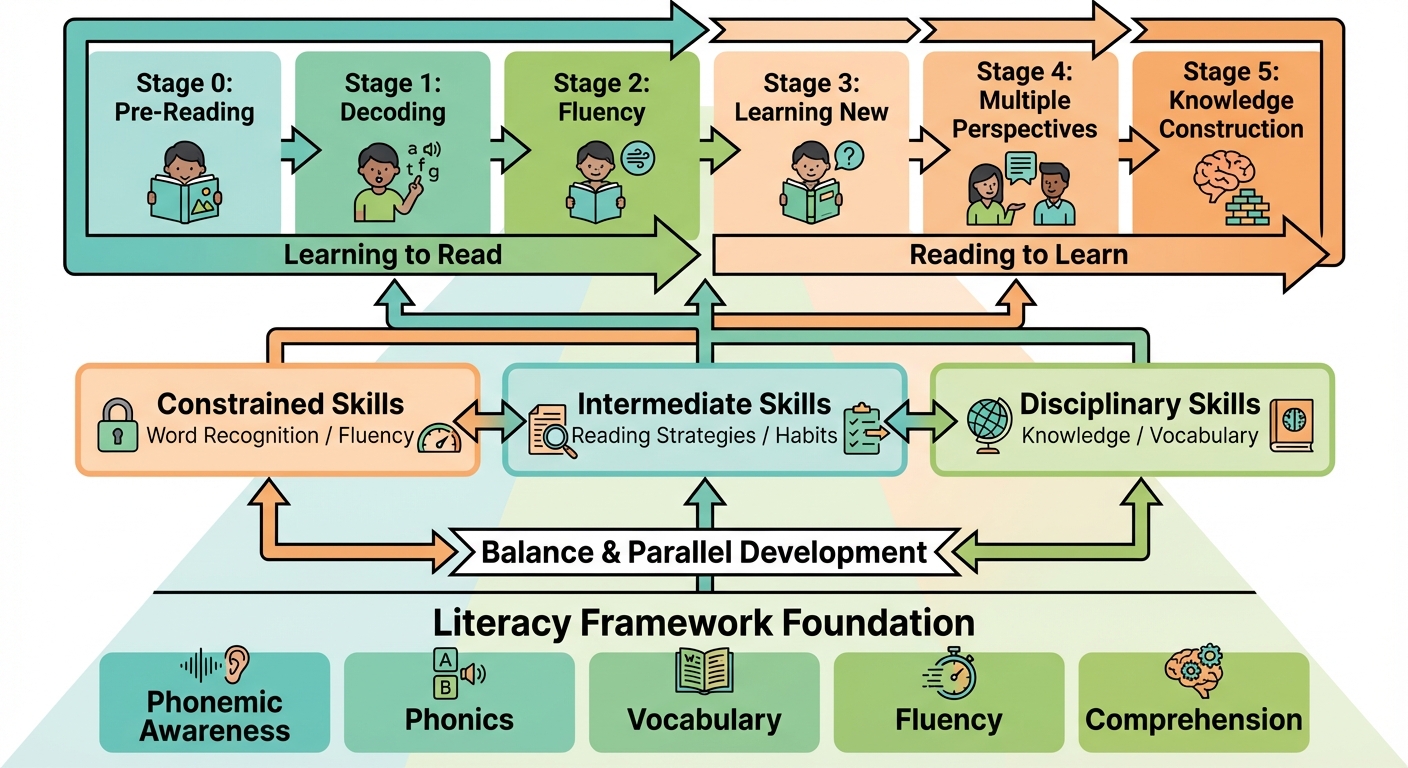
Alright, let’s peel back the layers on what makes a literacy framework tick. At its core, an effective framework integrates cognitive science, psychology, and practical pedagogy to create a holistic approach to reading and writing. Think of it as a well-oiled machine: Input is exposure to language, processing is comprehension and analysis, and output is fluent expression.
Step 1: Foundational Phonics—This is where you build the basics, like learning the alphabet as building blocks. Research suggests starting with sound-letter connections to decode words effortlessly.
Step 2: Vocabulary Expansion—Not just memorizing words, but understanding them in context, like adding spices to a dish for depth.
Step 3: Comprehension Strategies—Here, we teach active reading: questioning, summarizing, and inferring. It’s like being a detective in a mystery novel, piecing clues together.
Step 4: Fluency and Application—Practice through diverse texts, from books to blogs, ensuring skills transfer to real life. The beauty? It’s adaptive—tailored to age, interests, and needs, making it sustainable.
To illustrate the shift, here’s a comparison of the old versus new ways:
| Aspect | Old Way (Traditional Methods) | New Framework (Integrated Approach) |
|---|---|---|
| Focus | Rote drills and isolated skills | Holistic integration of reading, writing, and critical thinking |
| Engagement | Boring worksheets, low motivation | Interactive, interest-based activities like storytelling games |
| Outcomes | Surface-level reading, high forgetting rates | Deep comprehension, lifelong learning habits |
| Adaptability | One-size-fits-all, rigid curriculum | Personalized, tech-assisted progression |
Practical Use Cases & Application
So, how does this literacy framework shake up your daily life? Let’s get concrete with examples tailored to self-growth and productivity.
Example 1: In the Workplace—Imagine you’re a manager sifting through reports. With a strong framework, you don’t just read; you analyze trends and spot inefficiencies. One perspective is that this boosts productivity by up to 20%, as per workplace studies, turning you into the go-to problem-solver.
Example 2: Personal Development—For avid self-learners, it’s like upgrading from a bicycle to a sports car. You dive into books on psychology or history, applying insights to build better habits. Consider the risks of misinformation; a solid framework helps you fact-check like a pro.
Example 3: Parenting or Teaching—If you’re guiding kids, this changes game nights into literacy adventures. Turn reading time into interactive stories, fostering curiosity without the boredom. Research suggests this leads to higher engagement and better long-term retention.
Example 4: Digital Navigation—In our scroll-happy era, it equips you to dissect social media posts or news articles, avoiding echo chambers. It’s productive armor against fake news, enhancing decision-making in everything from voting to online shopping.
Educational Action Plan (How to Start)
Ready to build your own literacy fortress? Here’s a step-by-step guide, starting simple and scaling up safely. Remember, this is educational—focus on learning, not quick fixes.
Level 1 (Learn): Begin by exploring basics. Read introductory articles on literacy science from reputable sources like education journals. Watch free videos on platforms like Khan Academy about phonics and comprehension. Check out books such as “The Reading Mind” for a deeper dive into how brains process language. Aim for 15-20 minutes daily to build knowledge without overwhelm.
Level 2 (Try Safely): Start small-scale experiments. For instance, pick a short article and practice active reading: Highlight key points, summarize in your own words, and question assumptions. Join a local book club or online forum for discussion—it’s a low-risk way to apply skills. Track progress in a journal, noting improvements in speed and understanding. If teaching others, test interactive methods like role-playing stories, always prioritizing fun and voluntary participation. Consider the risks, like frustration from overambition; scale back if needed.
Conclusion & Future Outlook
In summary, building a literacy framework that works balances rewards like enhanced critical thinking and personal empowerment against risks such as initial time investment or adapting to new methods. The effort pays off in gains—better productivity, informed decisions, and a love for learning—but it’s not without uncertainty. What if AI takes over more writing tasks? Watch for evolutions in edtech, like adaptive apps that personalize frameworks further. One perspective is that by 2030, literacy will evolve to include digital fluency as standard. Stay curious, experiment responsibly, and remember: Words are your wand—wield them wisely.

👨💻 Author: SnowJon (Web3 & AI Practitioner / Investor)
A researcher who leverages knowledge gained from the University of Tokyo Blockchain Innovation Program to share practical insights on Web3 and AI technologies.
His motto is to translate complex technologies into forms that anyone can evaluate and use responsibly, fusing academic knowledge with practical experience.
*AI may assist drafting and structuring, but final verification and responsibility remain with the human author.
References
- Building a Literacy Framework That Works
- U.S. Department of Education – Literacy Resources
- Wikipedia – Literacy Overview
- Reading Rockets – Evidence-Based Literacy Strategies
- NCBI – The Science of Reading: A Review
- OECD – Literacy in the 21st Century
▼ AI tools to streamline research and content production (free tiers may be available)
Free AI search & fact-checking
👉 Genspark
Recommended use: Quickly verify key claims and track down primary sources before publishing
Ultra-fast slides & pitch decks (free trial may be available)
👉 Gamma
Recommended use: Turn your article outline into a clean slide deck for sharing and repurposing
Auto-convert trending articles into short-form videos (free trial may be available)
👉 Revid.ai
Recommended use: Generate short-video scripts and visuals from your headline/section structure
Faceless explainer video generation (free creation may be available)
👉 Nolang
Recommended use: Create narrated explainer videos from bullet points or simple diagrams
Full task automation (start from a free plan)
👉 Make.com
Recommended use: Automate your workflow from publishing → social posting → logging → next-task creation
※Links may include affiliate tracking, and free tiers/features can change; please check each official site for the latest details.