Personally, understanding Animal Spirits reveals how emotions often override market logic.#AnimalSpirits #MarketPsychology
Quick Video Breakdown: This Blog Article
This video clearly explains this blog article.
Even if you don’t have time to read the text, you can quickly grasp the key points through this video. Please check it out!
If you find this video helpful, please follow the YouTube channel “LifeNextDaily,” which delivers daily news.
https://www.youtube.com/@LifeNextDaily
Read this article in your native language (10+ supported) 👉
[Read in your language]
Animal Spirits: Is the Stock Market Invincible?
⚠️ WARNING: Technology and investments involve risks. This is not financial advice. DYOR (Do Your Own Research).
High-Impact Intro: Riding the Market’s Wild Side
👋 Hey, Market Mavericks! Ever feel like the stock market is that unbreakable superhero in a blockbuster movie—dodging crashes, soaring through volatility, and always landing on its feet? Well, in 2026, with “animal spirits” roaring back louder than ever, it’s tempting to think the market might just be invincible. But is it? This concept, coined by economist John Maynard Keynes, refers to the emotional, irrational forces that drive investor behavior—think optimism, fear, greed, and that gut-feeling hunch that sends stocks skyrocketing or plummeting.
Why does this matter now? As we kick off 2026, recent reports from sources like Morgan Stanley highlight a surge in mergers and acquisitions, with healthcare and industrials leading the charge amid AI integrations and economic shifts. Wall Street analysts, including those at Kiplinger and Morningstar, predict the bull market could keep running, fueled by tax cuts, dropping interest rates, and falling oil prices. But hold on—one investing legend like Mohamed El-Erian warns of potential stumbles from geopolitics and economic changes that could hit the AI-driven surge. We’re in an era where pet care stocks, spirits industry trends, and even under-the-radar meme buys are buzzing, but beneath the hype, it’s crucial to question if this invincibility is real or just a collective illusion. In this post, we’ll unpack the wits behind animal spirits, using humor, analogies, and balanced insights to help you navigate without the fluff. Let’s dive in—objectively, of course.
The Problem (The “Why”): When Emotions Hijack the Wheel
Imagine the stock market as a massive highway jam-packed with drivers: some are cautious grandparents creeping along, others are adrenaline-junkie teens flooring the gas. Now, toss in “animal spirits”—those wild, unpredictable impulses that make everyone swerve erratically. In the old way, investing was like playing poker with blindfolds on; you’d rely on gut feelings, hot tips from friends, or media frenzy, often leading to costly wrecks. What was hard? Predicting human behavior. Expensive? The fees from panic-selling or overbuying during bubbles. Risky? Absolutely—remember the dot-com bust or the 2008 crash, where irrational exuberance turned into mass hysteria?
The bottleneck here is psychological: animal spirits amplify biases like herd mentality (everyone’s buying, so you do too) or loss aversion (dumping stocks at the first dip). Economically, this creates volatility that can wipe out gains overnight. Without understanding this, beginners chase highs, intermediates get burned by overconfidence, and everyone wonders why the market feels like a rigged game. But hey, if markets were rational, we’d all be billionaires sipping coffee with Warren Buffett—spoiler: we’re not.
Under the Hood: How Animal Spirits Drive the Market
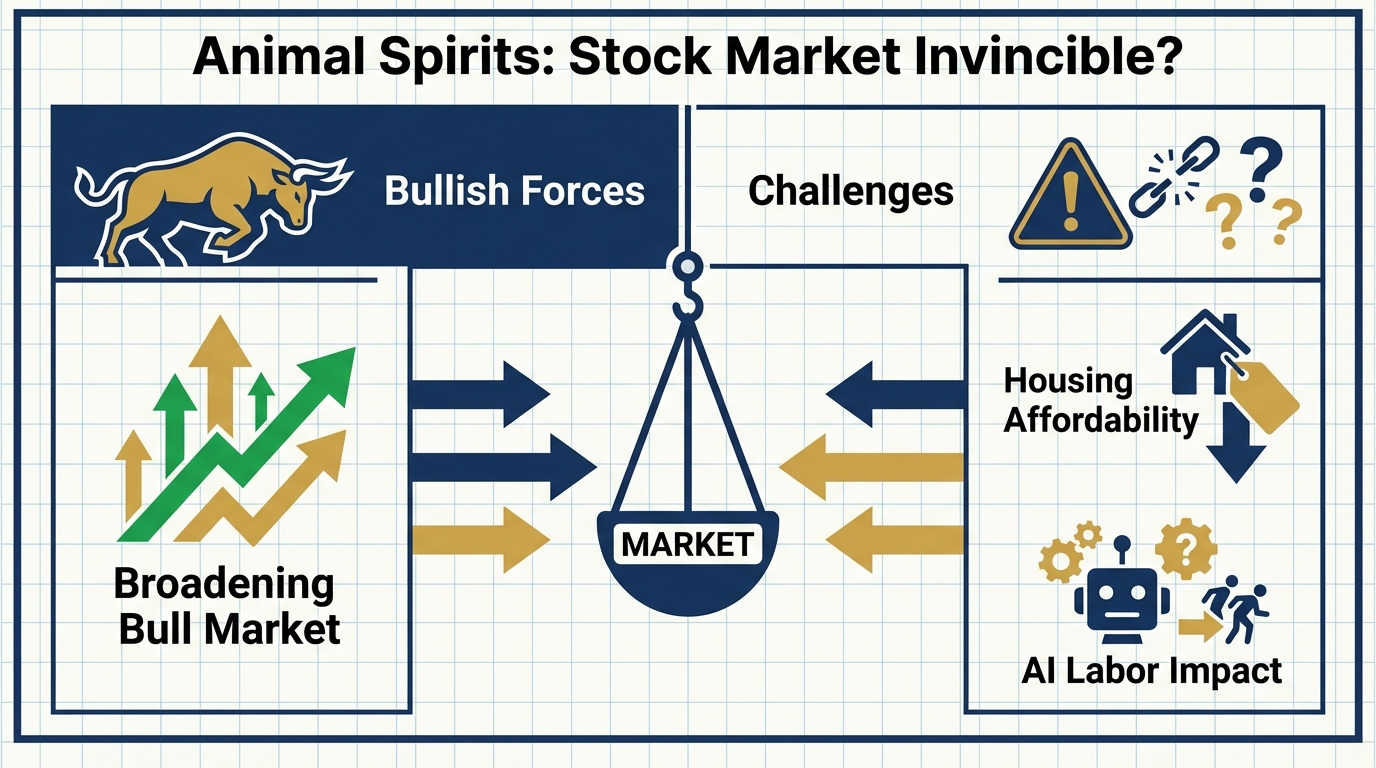
Alright, let’s break this down like dissecting a quirky family recipe—simple ingredients, but the mix can create a feast or a disaster. Animal spirits aren’t some mystical force; they’re rooted in behavioral economics. Step 1: Optimism builds from positive news (like AI booms or rate cuts), sparking buying sprees. Step 2: This creates momentum—stocks rise because, well, they’re rising, pulling in more investors. Step 3: But flip the script with bad vibes (geopolitical tensions or inflation spikes), and fear triggers sell-offs. It’s a feedback loop where emotions override fundamentals, like a crowd at a concert rushing the stage because one person started it.
For beginners: Think of it as market psychology on steroids. Intermediates might recognize patterns from Keynes’ theory—spirits explain why bubbles form even when valuations scream “overpriced.” In 2026, with reports of M&A renaissances and sector rotations (tech lagging while industrials surge), these spirits are supercharged by AI hype and policy changes. But remember, they’re not invincible; history shows they can crash hard when reality bites.
| Aspect | Old Way (Rational Models) | New Way (Incorporating Animal Spirits) |
|---|---|---|
| Decision-Making | Based solely on data and efficiency (e.g., efficient market hypothesis assumes perfect info) | Accounts for emotions and biases, using behavioral finance to predict irrational swings |
| Risk Assessment | Ignores psychological factors, leading to underestimation of bubbles or crashes | Integrates sentiment analysis (e.g., via AI tools scanning news/social media) for better volatility forecasts |
| Market Outcomes | Assumes steady, predictable growth; surprises hit hard | Expects cycles of exuberance and despair, encouraging diversified, long-term strategies |
| Examples in 2026 | Over-relying on tech giants amid AI hype, ignoring rotation to industrials | Monitoring M&A trends in healthcare, balancing portfolios against geopolitical risks |
Practical Use Cases & Application: Spirits in Everyday Investing
How does this change your daily life or decisions? Let’s get concrete. First, for a beginner saving for retirement: Animal spirits explain why your 401(k) might spike during bull runs—ride the wave cautiously by diversifying, not chasing memes like that under-the-radar pet stock buzzing in January 2026 reports. One perspective is to view market dips as buying opportunities, but consider the risks of timing it wrong.
Second, an intermediate trader eyeing sectors: With 2026 trends showing US stocks outperforming international ones (thanks to Fidelity insights on earnings lifts), spirits could fuel rotations—say, from tech to industrials. This might mean reassessing your portfolio, but research suggests focusing on fundamentals over hype to avoid bubbles.
Third, in work life: If you’re in finance or tech, understanding spirits helps in client advising—explaining why AI integrations are driving M&A fever without promising invincibility. For entrepreneurs, it’s a reminder that market sentiment can boost or bust funding rounds.
Fourth, personal finance angle: Picture budgeting like taming a wild animal—spirits influence consumer trends (e.g., pet care market growing at 6.2% CAGR per AMR reports), so aligning investments with real trends beats emotional impulses.
Educational Action Plan: How to Start Taming the Spirits
Ready to level up without the hype? Here’s a step-by-step guide, keeping it educational and risk-aware.
Level 1 (Learn): Start by reading classics like Keynes’ “The General Theory” excerpts on animal spirits or modern takes from behavioral economists like Daniel Kahneman’s “Thinking, Fast and Slow.” Check free resources on sites like Investopedia for sentiment indicators. Watch TED Talks on market psychology to grasp biases—aim for 30 minutes a day to build foundational knowledge.
Level 2 (Try Safely): In a test environment, like a paper trading app (no real money), track a small watchlist of stocks mentioned in 2026 trends—e.g., pet food or healthcare sectors. Practice journaling why you’d “buy” or “sell” based on news, noting emotional pulls vs. data. Consider risks by simulating scenarios: What if geopolitics tanks the market? This builds habits without financial exposure. Remember, this is for learning—volatility is real, so scale small and learn from simulations.
Conclusion & Future Outlook: Balancing the Bull and the Bear
In summary, animal spirits make the stock market feel invincible, driving 2026’s bull run with AI, M&A, and sector shifts—but they’re double-edged, with risks like economic stumbles or overvaluations lurking. Rewards? Potential gains for the prepared. Effort? High in education, low in impulsive moves. Uncertainty abounds; watch for inflation data, policy changes, or AI integrations as per Morningstar and Kiplinger outlooks. Stay analytical, and remember: markets aren’t invincible, but informed strategies can make you more resilient.

👨💻 Author: SnowJon (Web3 & AI Practitioner / Investor)
A researcher who leverages knowledge gained from the University of Tokyo Blockchain Innovation Program to share practical insights on Web3 and AI technologies.
His motto is to translate complex technologies into forms that anyone can evaluate and use responsibly, fusing academic knowledge with practical experience.
*AI may assist drafting and structuring, but final verification and responsibility remain with the human author.
References
- Animal Spirits: Is the Stock Market Invincible?
- “Animal Spirits” Return: Morgan Stanley Signals M&A Renaissance
- What’s in Store for the Stock Market in 2026? | Kiplinger
- Is a Stock Market Rotation Underway? These Sectors Are Outpacing Tech in 2026 | Morningstar
- 3 reasons the stock market’s AI surge will stumble in 2026, according to one investing legend
▼ AI tools to streamline research and content production (free tiers may be available)
Free AI search & fact-checking
👉 Genspark
Recommended use: Quickly verify key claims and track down primary sources before publishing
Ultra-fast slides & pitch decks (free trial may be available)
👉 Gamma
Recommended use: Turn your article outline into a clean slide deck for sharing and repurposing
Auto-convert trending articles into short-form videos (free trial may be available)
👉 Revid.ai
Recommended use: Generate short-video scripts and visuals from your headline/section structure
Faceless explainer video generation (free creation may be available)
👉 Nolang
Recommended use: Create narrated explainer videos from bullet points or simple diagrams
Full task automation (start from a free plan)
👉 Make.com
Recommended use: Automate your workflow from publishing → social posting → logging → next-task creation
※Links may include affiliate tracking, and free tiers/features can change; please check each official site for the latest details.