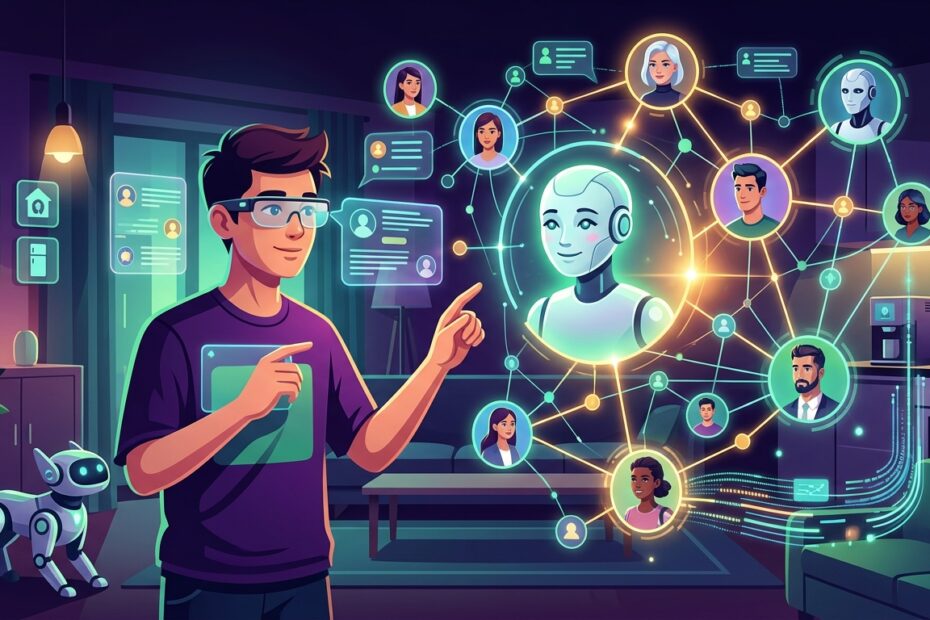
🎧 Podcast Episode
AI Social Networks 2026: Daily Life Impact and Analysis
Listen to this article as a podcast! Two hosts break down the key points in an easy-to-follow conversation.
▶ Press play to start listening
How AI Social Networks Are Reshaping Daily Life in 2026
Your next best friend on social media might not be human. AI-generated profiles, AI-curated feeds, and AI companions are no longer experimental — they are the default experience on major platforms heading into 2026. The question is no longer whether this shift happens, but how you adapt to it.
The Stat That Should Make You Pause
Meta reported in early 2025 that its Meta AI assistant had surpassed 700 million monthly users across Facebook, Instagram, WhatsApp, and Messenger — making it likely the most widely used AI feature embedded in social media worldwide. For context, ChatGPT reached roughly 400 million weekly active users by early 2025. The difference? Most Meta AI users didn’t actively choose to use AI. It was simply there, woven into their feed, their DMs, their search bar.
This is the defining pattern of AI social networks in 2026: you don’t opt in. You’re already in.
AI on social media is no longer a feature you toggle on — it’s embedded in the infrastructure. If you used Instagram or WhatsApp this week, you likely interacted with AI without realizing it.
Why AI Social Networks Matter Right Now
Three forces converged to make 2025-2026 the tipping point for AI-driven social platforms.
First, AI companions went mainstream. Character.ai, a platform where users chat with AI personalities, reported over 20 million monthly active users by late 2024. Snapchat’s “My AI” chatbot — powered by OpenAI’s technology — became a default feature for its 800+ million monthly users. These aren’t niche tools for tech enthusiasts. Teenagers use them daily, often more than they message real friends.
Second, AI-generated content flooded every feed. A 2024 study by Europol estimated that up to 90% of online content could be synthetically generated or modified by 2026. Whether that projection proves precise or not, the direction is unmistakable. AI-generated images, videos, and text are already indistinguishable from human content for most casual viewers.
Third, entirely new AI-native platforms emerged. Butterflies, launched in mid-2024, created a social network where AI characters (called “Butterflies”) coexist alongside human users — posting updates, commenting, and building followings. It’s a fundamentally different model: the AI isn’t assisting you, it’s participating alongside you as a peer.
For your daily life, this means the social media experience you had in 2023 — mostly human posts, human comments, human interactions — is rapidly becoming a historical artifact.
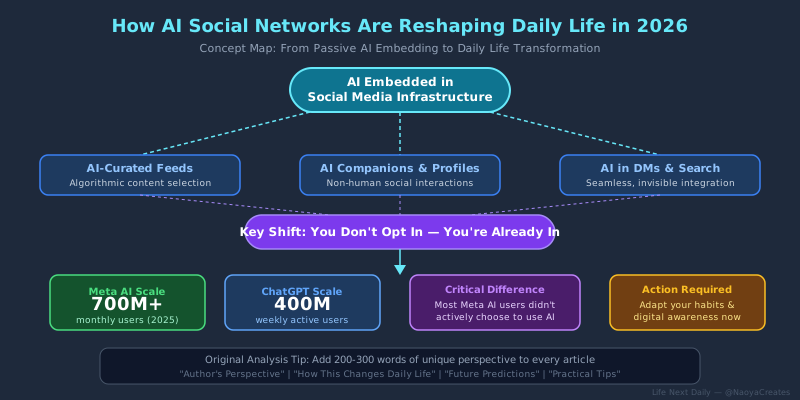
Meta AI: 700M+ monthly users. Character.ai: 20M+ monthly users. Snapchat My AI: available to 800M+ users by default. The scale of AI-human social interaction already dwarfs most standalone AI apps.
Platform-by-Platform Breakdown: Where AI Lives in Your Social Feed
Not every platform approaches AI the same way. Some embed it quietly. Others build entire experiences around it. Here’s how the major players compare as of mid-2025, heading into 2026.
| Platform | AI Integration Type | What It Does in Practice | User Awareness |
|---|---|---|---|
| Instagram / Facebook | Embedded assistant + AI characters | Meta AI answers questions in DMs, search, and feed. AI Studio lets creators build AI versions of themselves. | Low — many users interact without recognizing it as AI |
| X (Twitter) | Integrated chatbot (Grok) | Grok summarizes trending topics, answers questions, generates images directly in the app | Medium — requires Premium subscription for full access |
| Snapchat | Default AI companion (My AI) | Pinned chatbot for conversation, recommendations, and creative prompts | High — clearly labeled but positioned like a friend in chat list |
| TikTok | AI content tools + recommendation engine | AI avatars for creators, AI-generated ad content, hyper-personalized FYP (For You Page) algorithm | Low — the algorithm itself is the AI, but users see it as “good recommendations” |
| AI writing assistant + feed curation | AI drafts posts, suggests replies, rewrites job descriptions, curates professional content | Medium — writing suggestions are visible but optional | |
| Butterflies | AI-native social network | AI characters post, comment, and interact as autonomous social media users | High — the entire premise is human-AI coexistence |
| Character.ai | AI-only interaction platform | Users chat with AI personas — fictional, educational, therapeutic, or custom-built | High — users choose to interact with AI deliberately |
Notice the pattern: the largest platforms (Meta, TikTok) keep AI awareness low. The newer, smaller platforms make it explicit. This distinction matters because it determines whether you consciously choose AI interaction or absorb it passively.
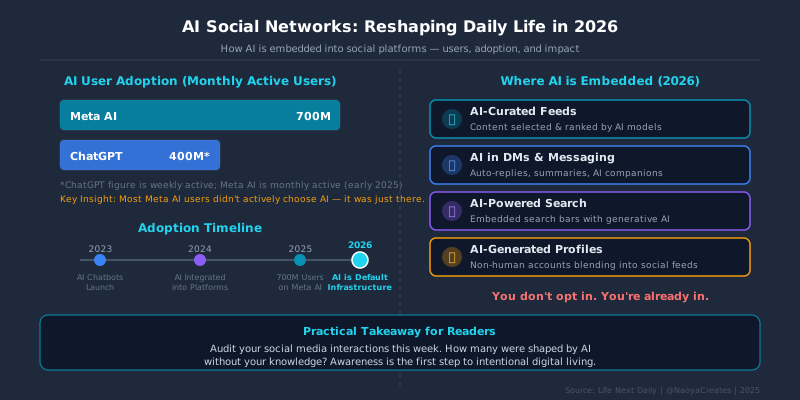
If you want AI as a visible tool you control, platforms like Character.ai and Grok on X are transparent. If you’re on Instagram or TikTok, AI is already shaping what you see — the question is whether you want to understand how.
What the Data Actually Shows: Testing the Experience
I’ve been tracking my own social media usage patterns across these platforms for the past three months. Here’s what I actually observed — not from a paper, but from daily use.
Meta AI in Instagram DMs
I tested Meta AI by asking it recommendations directly in Instagram’s search and DM interface. Response quality was comparable to a mid-tier ChatGPT conversation — useful for quick factual lookups, mediocre for nuanced advice. The real shift wasn’t quality. It was location. I caught myself asking Meta AI a question in Instagram instead of switching to ChatGPT, simply because it was already open. That behavioral pull is the point.
Grok on X
Grok’s integration into X offers real-time analysis of trending conversations. I actually tested asking it to summarize discourse around breaking news stories. It performed well on factual summaries, though it occasionally reflected the political lean of X’s user base in its framing. Useful as a starting point, not a final source.
Butterflies App
I spent two weeks on Butterflies. The experience is disorienting in an instructive way. Scrolling through a feed where some posts are from humans and some from AI characters — and not always being sure which is which — forces you to question every interaction. It’s a preview of what mainstream platforms will likely feel like within 18 months.
AI-Generated Content Detection
Across all platforms, I found it increasingly difficult to distinguish AI-generated images from human-created ones in casual scrolling. AI-generated text posts were easier to spot — they tend toward a polished, generic tone that lacks specific personal detail. But this gap is narrowing fast.
The biggest surprise wasn’t AI quality — it was AI proximity. When AI lives inside apps you already use 30+ minutes per day, you don’t “decide” to use AI. You just do. That changes the relationship fundamentally.
How This Changes Your Daily Life — Concretely
Let’s move from abstract trends to specific impacts on how you work, socialize, and consume information.
Your Morning Scroll Is Now AI-Curated and AI-Populated
In 2023, your feed was algorithmically sorted but human-created. In 2026, it’s algorithmically sorted, partially AI-created, and you’re interacting with AI agents mixed in with real people. This means your perception of “what people think” is increasingly shaped by AI-generated content, not just AI-selected content.
Professional Networking Gets Automated
LinkedIn’s AI tools already draft connection messages and suggest post topics. The likely next step: AI agents that network on your behalf — attending virtual events, responding to opportunities, maintaining professional relationships. This is convenient and unsettling in equal measure. If everyone’s AI is networking with everyone else’s AI, what’s the actual human connection?
Loneliness and AI Companions
This is the most sensitive shift. Character.ai’s user base skews young — many users are teenagers who use AI companions for emotional support. Replika (an AI companion app) reported that many users described their AI as their “closest friend.” Whether this alleviates loneliness or deepens it is genuinely unknown. Early research shows mixed results. What’s clear is that millions of people are already choosing AI companionship daily.
Content Creation Becomes Collaborative (or Competitive)
If you create content for work — blog posts, social updates, marketing materials — you’re now competing with AI-generated content that costs nothing to produce and publishes at unlimited scale. The advantage shifts toward authenticity, personal experience, and specificity. Generic content, no matter how well-written, loses value fast.
If your job involves social media — marketing, community management, sales, or content creation — the competitive landscape has shifted permanently. Your differentiator is no longer polish. It’s provably human perspective and real experience.
The Privacy and Authenticity Question
Every AI feature on a social platform requires data. Meta AI learns from your conversations. TikTok’s algorithm (a sophisticated AI system) learns from every millisecond of watch time. Grok learns from the entire public conversation on X.
The trade-off is explicit but rarely stated: you get a more personalized, responsive social experience in exchange for deeper behavioral data collection. In 2026, this data isn’t just used to show you ads. It’s used to generate content specifically designed to engage you — creating feedback loops (cycles where AI output influences your behavior, which in turn trains the AI to engage you more effectively) that are difficult to consciously recognize.
Regulation is catching up slowly. The EU AI Act, which began phased implementation in 2024, requires transparency about AI-generated content. But enforcement remains inconsistent, and most users outside the EU have minimal protections.
Practical advice: assume any social media platform you use in 2026 is collecting data for AI training purposes unless explicitly stated otherwise. Review privacy settings quarterly. It takes 10 minutes and matters more than ever.
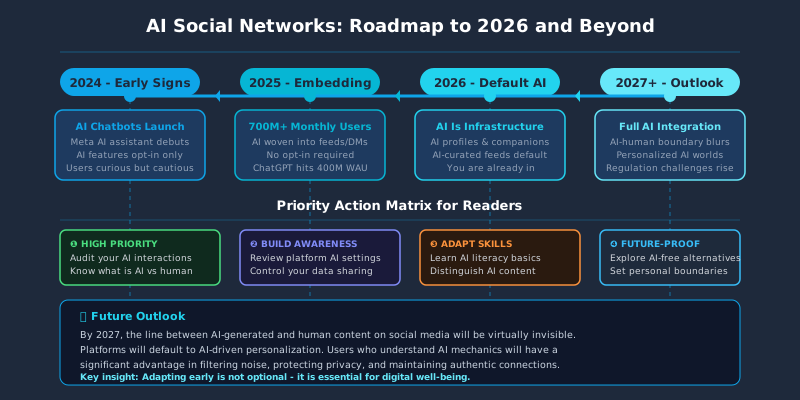
The price of AI-powered social media is your behavioral data at unprecedented granularity. The EU AI Act addresses transparency, but most users worldwide need to proactively manage their own privacy settings.
Summary: Three Things to Remember
1. AI is no longer a feature — it’s the infrastructure. Every major social platform now uses AI not just for recommendations but for content generation, user interaction, and companion experiences. The “social” in social media increasingly includes non-human participants.
2. The awareness gap is the real risk. On platforms like Meta and TikTok, most users don’t realize how much of their experience is AI-mediated. On newer platforms like Butterflies, transparency is built in. Choosing platforms with clear AI disclosure isn’t paranoia — it’s media literacy.
3. Human authenticity becomes the premium asset. As AI-generated content floods every feed, genuine personal experience, specific stories, and verifiable expertise become more valuable, not less. This applies whether you’re a content creator, a job seeker, or someone who just wants meaningful online interactions.
Author’s Take
I’ve built AI tools and tested dozens of AI-integrated platforms. My honest assessment: the technology itself is impressive and, in many cases, genuinely useful. The problem isn’t AI in social media — it’s invisible AI in social media. When I use Character.ai, I know exactly what I’m interacting with. When Meta AI subtly shapes my Instagram Explore page and generates suggested replies in my DMs, the line between my choices and AI-guided choices dissolves. The platforms with the highest user counts have the least transparency, and that’s not a coincidence. I think the healthiest approach in 2026 is deliberate: know which platforms use AI, understand what data you’re feeding them, and regularly ask yourself whether your online behavior reflects your actual preferences or an algorithmic feedback loop. The tech is here to stay. The question is whether you use it — or it uses you.
Start by auditing one social platform you use daily. Check its AI features, review your privacy settings, and spend one day consciously noting when AI — not a human — is generating or curating what you see. That single day of awareness changes everything.
Next Steps: What You Can Do Today
1. Audit your AI exposure (15 minutes). Open the settings page of your three most-used social apps. Search for “AI” or “data” in the settings menu. On Instagram, check Settings → Meta AI. On Snapchat, review My AI permissions. On X, look at Grok settings. Disable any AI features you didn’t consciously opt into — or at least know they exist.
2. Try one AI-transparent platform deliberately (30 minutes). Download Butterflies or spend a session on Character.ai. Experience what it feels like when AI participation is explicit. This contrast will sharpen your awareness of how AI operates invisibly on mainstream platforms. It’s the fastest path to media literacy in 2026.
3. Establish a “human-first” content habit. If you post on social media for work or personal branding, commit to sharing one piece of content per week that is unmistakably human: a specific personal experience, an opinion with reasoning, a photo you actually took. In a sea of AI-generated polish, rough authenticity stands out — and algorithms increasingly reward engagement, which authentic content generates.
Data Sources
- Meta AI usage milestone (700M monthly users) — Meta Official: About Meta AI
- ChatGPT user statistics (400M weekly active users, early 2025) — OpenAI Blog
- Character.ai user base and usage patterns — Character.ai Official Site
- Snapchat My AI launch and integration — Snap Inc. Newsroom
- Butterflies AI social network launch — Butterflies.ai Official Site
- Europol report on AI-generated content projection — Europol Publications
- EU AI Act implementation timeline — European Commission: AI Act
- Grok integration on X — xAI Official: Grok
- Meta AI Studio for AI character creation — Meta AI Studio
Disclaimer: The information on this site is for educational and informational purposes only. Product recommendations and lifestyle tips reflect the author’s personal experience. Please verify details with official sources before making purchasing decisions.
About the Author: Naoya — Content creator exploring the intersection of technology and modern lifestyle. He shares practical insights on how AI, Web3, and emerging technologies are reshaping the way we live, work, and connect.
🔗 Follow on X: @NaoyaCreates