From experience, prioritizing Sleep Quality becomes critical when hitting that midlife slump.#SleepHealth #MidlifeWellness
Quick Video Breakdown: This Blog Article
This video clearly explains this blog article.
Even if you don’t have time to read the text, you can quickly grasp the key points through this video. Please check it out!
If you find this video helpful, please follow the YouTube channel “LifeNextDaily,” which delivers daily news.
https://www.youtube.com/@LifeNextDaily
Read this article in your native language (10+ supported) 👉
[Read in your language]
Research Shows This Is The Age When Sleep Quality Is At Its Worst
⚠️ DISCLAIMER: This article is for informational purposes only and does not constitute medical advice. Always consult a healthcare professional.
High-Impact Intro
👋 Hello, Health Hackers! Ever feel like your 40s are hitting you with a double espresso of life chaos, leaving your sleep as wrecked as a smartphone after a toddler’s playtime? Well, buckle up, because recent research is shining a spotlight on why this decade might be the ultimate sleep saboteur. According to a study highlighted on mindbodygreen.com, folks in their 40s are experiencing the nadir of sleep quality—part of a fascinating “U-shaped” curve where sleep gets worse before it gets better. Why does this matter now? In our always-on world of work stress, family demands, and that sneaky screen time, understanding this dip can be a game-changer for reclaiming your rest. We’re talking about more than just feeling groggy; poor sleep links to everything from mood swings to long-term health risks. But don’t worry—we’ll unpack this wittily, scientifically, and with tips that encourage you to explore responsibly. Let’s dive in with some eye-opening stats: Research shows that 40-year-olds average the least amount of sleep, often dipping below the recommended 7-9 hours, thanks to a cocktail of midlife pressures.
The Problem (The “Why”)
John: Alright, let’s cut through the fluff. Sleep quality hitting rock bottom in your 40s isn’t some cosmic joke—it’s biology and life stage colliding like a bad traffic jam. Imagine your body’s sleep system as a bustling highway: in your 20s, it’s smooth sailing with minimal traffic. But by 40, you’ve got kids as unpredictable roadblocks, career pressures as never-ending construction zones, and hormonal shifts throwing in potholes for good measure. The “old way” of powering through with caffeine and sheer willpower? That’s like ignoring a flat tire and hoping for the best—it leads to breakdowns, aka chronic fatigue, weakened immunity, and even heightened risks for conditions like heart disease or depression. Research suggests this U-shaped sleep curve means quality plummets in midlife due to stressors, then rebounds as life stabilizes in later years.
Lila: Whoa, John, that’s relatable! As the bridge for beginners, I’m thinking of all those parents juggling jobs and family. So, why is it specifically the 40s? Is it just busyness, or something deeper?
John: Spot on, Lila. It’s a mix. Biologically, melatonin production can wane, circadian rhythms get disrupted by irregular schedules, and psychological bottlenecks like anxiety over finances or aging add fuel to the fire. The old approach—treating sleep as optional—made it expensive in terms of health costs and risky for long-term well-being. No wonder studies show this age group reports the highest insomnia rates.
The Science Behind It
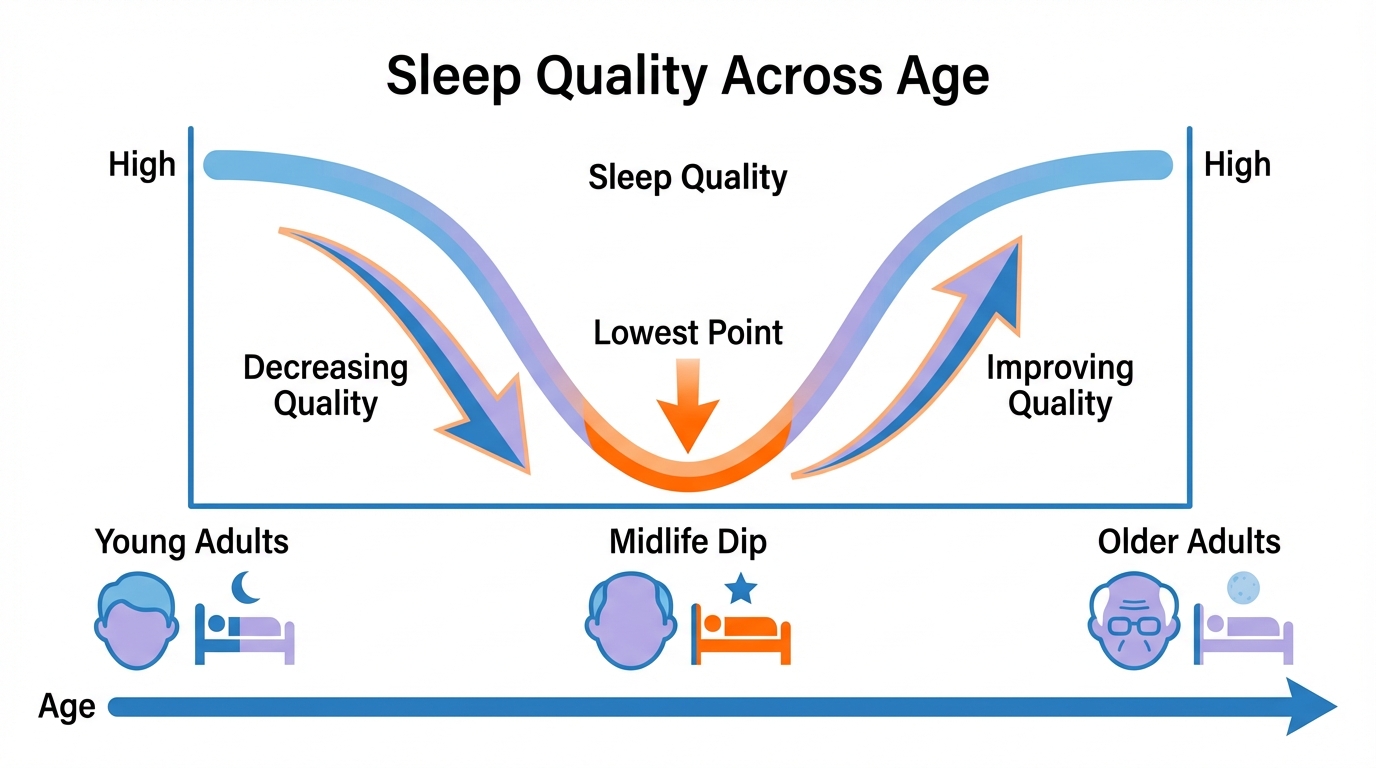
John: Under the hood, sleep isn’t just “shutting down”—it’s a complex orchestra conducted by your brain’s suprachiasmatic nucleus, the master clock syncing with light and darkness. In your 40s, this gets thrown off by elevated cortisol (stress hormone) levels, which research links to fragmented sleep stages. Step 1: Your body enters non-REM sleep for repair—think tissue rebuilding and immune boosting. Step 2: REM sleep kicks in for memory consolidation and emotional processing. But midlife stressors shorten these cycles, leading to that U-shape where 40-somethings hit the trough. Analogies help: It’s like a phone battery that drains faster under heavy use; without proper charging, it glitches.
Lila: Okay, that makes sense for us beginners. So, how does this compare to other ages?
| Age Group | Old Way (Common Challenges) | New Insights (From Research) |
|---|---|---|
| 20s-30s | Irregular schedules from partying or early career hustle lead to sleep debt. | Better recovery due to youthful resilience, but habits form here that worsen later. |
| 40s | Midlife squeeze: Work, kids, aging parents disrupt routines massively. | Lowest point in U-curve; studies show shortest sleep duration and poorest quality. |
| 50s+ | Menopause or health issues add interruptions. | Improvement as life pressures ease, leading to rebound in sleep efficiency. |
John: See that table? It highlights how the 40s are uniquely tough, but knowledge is power. Research suggests optimizing your environment—like dimming lights earlier—can mimic natural mechanisms to improve this.
Practical Use Cases & Application
Lila: So, how does this change daily life? Give us some real examples.
John: Absolutely. First, for the working parent: Imagine a 42-year-old manager—research indicates their sleep dip could lead to reduced focus at work. By understanding this, they might prioritize wind-down routines, turning chaotic evenings into calmer ones, potentially boosting productivity. Second, for fitness enthusiasts: Poor sleep in the 40s hampers recovery; one perspective is that acknowledging this encourages lighter workouts on low-sleep days, preventing injuries. Third, in relationships: Fragmented sleep heightens irritability—studies link it to more arguments. Applying this knowledge could mean couples syncing schedules for better mutual rest. Fourth, long-term health: It’s like investing in a savings account; addressing midlife sleep now might reduce future risks, making decision-making more proactive.
Lila: Love those! It’s empowering without being preachy.
Educational Action Plan (How to Start)
John: Let’s make this actionable, but remember, this is educational—consult pros for personalization.
Lila: Level 1: Learn.
John: Start by reading reputable sources like the National Sleep Foundation’s guides or watching TED Talks on circadian rhythms. Track your own sleep for a week using a simple journal to spot patterns— no fancy apps needed.
Lila: Level 2: Try Safely.
John: Experiment with small habits: Set a consistent bedtime, dim lights an hour before sleep to support melatonin. Consider the risks of overhauling everything at once—start gradual to avoid frustration. For example, try a 10-minute meditation to ease stress, or optimize your bedroom for coolness and darkness. Always prioritize safety; if sleep issues persist, seek professional advice.
Conclusion & Future Outlook
John: Wrapping up, the rewards of tackling this 40s sleep dip—better energy, mood, and health—far outweigh the effort, but risks like ignoring underlying issues remain. It’s a balance: Effort in habits yields gains, yet individual results vary.
Lila: What’s next?
John: Watch for emerging research on sleep tech or therapies, but uncertainty looms—lifestyle trumps gadgets. Stay curious and responsible.

👨💻 Author: SnowJon (Web3 & AI Practitioner / Investor)
A researcher who leverages knowledge gained from the University of Tokyo Blockchain Innovation Program to share practical insights on Web3 and AI technologies.
His motto is to translate complex technologies into forms that anyone can evaluate and use responsibly, fusing academic knowledge with practical experience.
*AI may assist drafting and structuring, but final verification and responsibility remain with the human author.
References
- Research Shows This Is The Age When Sleep Quality Is At Its Worst
- National Sleep Foundation: Sleep Studies and Research
- PubMed: Age-Related Changes in Sleep
- CDC: Sleep and Sleep Disorders
- Mayo Clinic: Sleep Tips for Adults
▼ AI tools to streamline research and content production (free tiers may be available)
Free AI search & fact-checking
👉 Genspark
Recommended use: Quickly verify key claims and track down primary sources before publishing
Ultra-fast slides & pitch decks (free trial may be available)
👉 Gamma
Recommended use: Turn your article outline into a clean slide deck for sharing and repurposing
Auto-convert trending articles into short-form videos (free trial may be available)
👉 Revid.ai
Recommended use: Generate short-video scripts and visuals from your headline/section structure
Faceless explainer video generation (free creation may be available)
👉 Nolang
Recommended use: Create narrated explainer videos from bullet points or simple diagrams
Full task automation (start from a free plan)
👉 Make.com
Recommended use: Automate your workflow from publishing → social posting → logging → next-task creation
※Links may include affiliate tracking, and free tiers/features can change; please check each official site for the latest details.