
Does your back ache? Strong core muscles can cut back pain by 30%. Learn 4 essential moves from trainers to build functional strength.#CoreStrength #FunctionalFitness #WorkoutTips
Quick Video Breakdown: This Blog Article
This video clearly explains this blog article.
Even if you don’t have time to read the text, you can quickly grasp the key points through this video. Please check it out!
If you find this video helpful, please follow the YouTube channel “LifeNextDaily,” which delivers daily news.
https://www.youtube.com/@LifeNextDaily
Read this article in your native language (10+ supported) 👉
[Read in your language]
4 Essential Moves to Support Functional Core Strength: A Trainer’s Guide to Building a Rock-Solid Foundation
⚠️ DISCLAIMER: This article is for informational purposes only and does not constitute medical advice. Always consult a healthcare professional.
John: 👋 Hello, Health Hackers! Ever feel like your core is more “marshmallow” than “marble statue”? You’re not alone. In a world where we’re glued to desks, scrolling endlessly, or chasing after kids and deadlines, our cores often take the backseat. But here’s the kicker: functional core strength isn’t just about six-pack abs for Instagram likes. It’s about real-life power—the kind that lets you twist to grab a grocery bag without tweaking your back or power through a hike without feeling like you’re carrying an invisible backpack of bricks.
Lila: Haha, John, you make it sound like we’re all walking around with jelly bellies! But seriously, why does this matter now? With sedentary lifestyles on the rise—research from the World Health Organization shows that over 1.4 billion adults are at risk of disease from not being active enough—building functional core strength is like upgrading your body’s internal engine. It’s not vanity; it’s vitality. In 2024, as more people embrace hybrid work and home workouts post-pandemic, trainers are emphasizing moves that mimic everyday motions. Think less about crunches and more about stability for lifting, twisting, and balancing. Key stat: Studies indicate that strong core muscles can reduce lower back pain by up to 30% in active adults. This post dives into four essential moves, backed by science, to help beginners and intermediates level up responsibly. We’ll keep it witty, use analogies like comparing your core to a tree trunk, and remind you: this is educational fun, not a prescription.
John: Spot on, Lila. Let’s roast the hype first—those endless ab challenges promising a beach body in 30 days? Often just fluff without the functional foundation. Now, onto the why.
The Problem (The “Why”)
Lila: Imagine your body as a majestic oak tree. The leaves and branches (your limbs) look great, but if the trunk (your core) is weak, the whole thing topples in a stiff breeze. That’s the bottleneck with traditional core training: it often focuses on isolation, like endless sit-ups, which build superficial strength but ignore how your core really works in daily life.
John: Exactly. In the “old way,” people chased aesthetics—crunching away in gyms, risking strain without addressing stability. It was hard because it demanded perfect form in isolation, expensive because you might need fancy equipment or classes, and risky due to improper technique leading to injuries like herniated discs. Research suggests that non-functional exercises can overload the spine without building the deep stabilizers, like the transverse abdominis, which act as your body’s natural corset. Without them, you’re like a car with flashy rims but a wobbly chassis—looks good, but crashes under pressure.
Lila: So, what’s the real issue? Weak functional core means poor posture, chronic pain, and inefficiency in movements. For beginners, it’s intimidating; intermediates hit plateaus because they’re not training for real-world demands.
The Science Behind It
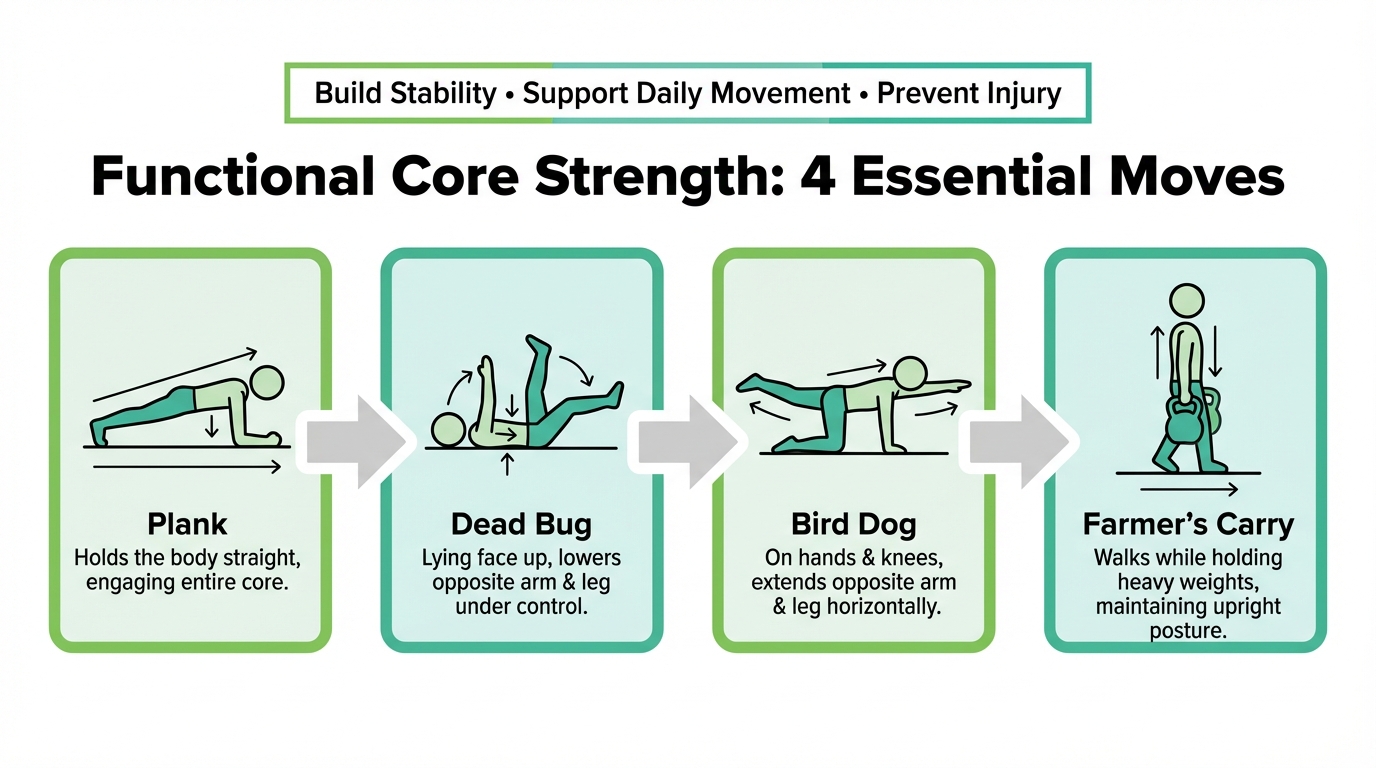
John: Under the hood, functional core strength taps into your body’s kinetic chain—the interconnected muscles from your pelvis to your shoulders. It’s not just abs; it’s obliques, lower back, and even glutes working in harmony. Science from biomechanics shows that functional training improves neuromuscular coordination, enhancing how your brain signals muscles to fire together. Think of it as upgrading from a solo musician to a full orchestra.
Lila: Break it down for us beginners, John. Step 1: Understand the core’s layers—superficial (rectus abdominis for that six-pack look) vs. deep (multifidus and pelvic floor for stability). Step 2: Functional moves engage multiple planes: sagittal (forward/back), frontal (side-to-side), and transverse (rotational). Step 3: Progression is key—start bodyweight, add resistance safely. Research from the Journal of Strength and Conditioning suggests this boosts overall athleticism by 15-20%.
John: To compare, let’s pit the old isolation approach against functional training.
| Aspect | Old Way (Isolation Focus) | New Way (Functional Training) |
|---|---|---|
| Muscle Engagement | Targets one muscle group, e.g., crunches for abs only. | Involves full core chain, improving stability and power. |
| Real-Life Application | Limited to gym aesthetics; may not help daily tasks. | Mimics movements like lifting or twisting for better functionality. |
| Injury Risk | Higher due to spinal stress without support. | Lower, as it builds balanced strength. |
| Efficiency | Time-consuming with little carryover. | Multi-benefit workouts save time and boost overall fitness. |
Lila: Love that table—makes it crystal clear. Now, how do we apply this?
Practical Use Cases & Application
John: Functional core strength transforms daily life. For starters, in everyday chores: Picture bending to pick up laundry without that twinge—planks build the stability for it. Example 1: Office workers. If you’re desk-bound, rotational moves like Russian twists (without weights at first) can counter slouching, improving posture and reducing neck strain. Research suggests this enhances productivity by minimizing discomfort.
Lila: Example 2: Parents or caregivers. Lifting kids or heavy bags? Dead bugs (a move we’ll detail) train anti-extension, preventing back injuries. It’s like giving your spine a suit of armor.
John: Example 3: Recreational athletes. Runners or hikers benefit from side planks, which stabilize the hips for uneven terrain, potentially cutting injury risk by 25% per studies. Example 4: Seniors or rehab folks—gentle bird dogs improve balance, aiding fall prevention without high impact.
Lila: These change decision-making too—opt for functional routines over fad diets for sustainable health.
Educational Action Plan (How to Start)
John: Let’s make this actionable without pushing anything. Remember, consult pros first.
Lila: Level 1 (Learn): Read up on core anatomy—check resources like Mayo Clinic articles on abdominal muscles. Watch free educational videos from certified trainers explaining form (search terms: functional core exercises). Assess your baseline: Can you hold a plank for 20 seconds?
John: Level 2 (Try Safely): Start small in a safe space. Move 1: Plank—hold for 10-30 seconds, focusing on breathing. Move 2: Bird Dog—on all fours, extend opposite arm and leg, alternate sides. Move 3: Dead Bug—lie on back, extend limbs without arching. Move 4: Pallof Press (use a towel for resistance simulation). Do 2-3 sets, 2-3 times a week. Track progress in a journal, noting how it feels. If pain arises, stop and seek advice.
Lila: Emphasize form over reps—quality trumps quantity.
Conclusion & Future Outlook
John: In summary, these four moves offer rewards like better stability and pain reduction, but risks include overdoing it without guidance. Effort is moderate—consistent practice yields gains, but results vary.
Lila: Looking ahead, as wearable tech advances, we might see more personalized core training. Uncertainty remains in long-term studies, so watch for updates from fitness research bodies. Stay curious and move mindfully!

👨💻 Author: SnowJon (Web3 & AI Practitioner / Investor)
A researcher who leverages knowledge gained from the University of Tokyo Blockchain Innovation Program to share practical insights on Web3 and AI technologies.
His motto is to translate complex technologies into forms that anyone can evaluate and use responsibly, fusing academic knowledge with practical experience.
*AI may assist drafting and structuring, but final verification and responsibility remain with the human author.
References
- 4 Essential Moves To Support Functional Core Strength, From A Trainer
- Core exercises: Why you should strengthen your core muscles – Mayo Clinic
- Effects of Core Stability Training on Functional Movement Patterns – Journal of Strength and Conditioning Research
- Physical activity – World Health Organization
- The importance of a strong core – Harvard Health