
Ever wonder if doom-scrolling is actually harming your brain? 300k scans show negative thinking physically alters your brain. Learn how to stop it.#BrainHealth #Neuroscience #Mindfulness
Quick Video Breakdown: This Blog Article
This video clearly explains this blog article.
Even if you don’t have time to read the text, you can quickly grasp the key points through this video. Please check it out!
If you find this video helpful, please follow the YouTube channel “LifeNextDaily,” which delivers daily news.
https://www.youtube.com/@LifeNextDaily
Read this article in your native language (10+ supported) 👉
[Read in your language]
This MD Analyzed 300k Brain Scans — This One Pattern Hurts Your Brain The Most
⚠️ DISCLAIMER: This article is for informational purposes only and does not constitute medical advice. Always consult a healthcare professional.
John: 👋 Hello, Health Hackers! Ever caught yourself in a doom-scrolling spiral, replaying that awkward conversation from last week like it’s a bad movie on repeat? Yeah, we’ve all been there. But what if I told you that this habit isn’t just messing with your mood—it’s literally reshaping your brain? Today, we’re diving into some groundbreaking insights from Dr. Daniel Amen, who analyzed over 300,000 brain scans and pinpointed negative thinking as the pattern that hurts your noggin the most. Based on a fascinating piece from mindbodygreen.com, this isn’t woo-woo self-help fluff; it’s backed by SPECT imaging that shows how rumination can shrink brain regions and amp up inflammation. Why does this matter now? In our always-on world of social media comparisons and global uncertainties, negative thinking is epidemic. Research suggests it contributes to everything from anxiety spikes to accelerated aging. But fear not—we’ll unpack the science, roast the myths, and arm you with practical tweaks. Stick around; your brain will thank you.
Lila: John, slow down! For us beginners, why is this a big deal in 2025? With AI tracking our moods and wellness apps everywhere, understanding our brain’s response to thoughts feels timely. It’s like upgrading your mental OS before it crashes.
John: Spot on, Lila. Context: Negative thinking isn’t new, but the data is. Dr. Amen’s clinic has scanned brains for decades, revealing patterns in 300,000+ images. The key finding? Chronic negativity correlates with reduced activity in the prefrontal cortex (your decision-making HQ) and heightened amygdala responses (fear central). It’s not just feeling blue; it’s physical wear and tear, potentially linking to issues like dementia risk. In a post-pandemic era where mental health is front-page news, this empowers us to rethink habits without the hype.
The Problem (The “Why”)
John: Let’s kick this off with an analogy: Imagine your brain as a bustling city. Positive thoughts are like efficient traffic—smooth flows, quick deliveries, everyone gets where they need to go. But negative thinking? That’s a perpetual gridlock, with honking horns, exhaust fumes, and crumbling roads. In the “old way,” we’d brush it off as “just stress” or rely on sheer willpower to snap out of it, like willing traffic to move by yelling at your dashboard. But science shows this pattern erodes neural pathways over time.
Lila: Okay, but what’s really happening under the hood? Why is negativity such a brain bully?
John: Great question. Biologically, chronic negative rumination triggers the release of stress hormones like cortisol, which in high doses can shrink the hippocampus (your memory center) and inflame tissues. Psychologically, it creates a feedback loop: One bad thought leads to another, like a video game where enemies multiply if you don’t level up. Economically—wait, not really, but think of the “cost”: Lost productivity, strained relationships, and even higher healthcare bills from related conditions. The old approach was reactive—pop a pill or ignore it—which often masked symptoms without addressing the root. Research suggests this pattern accelerates brain aging, with scans showing decreased blood flow in key areas. It’s risky because it’s insidious; you don’t notice until the damage compounds, much like ignoring small leaks in a dam until the flood hits.
Lila: Yikes, that hits home. So, for beginners, it’s like overwatering a plant—too much negativity drowns the roots, stunting growth.
The Science Behind It
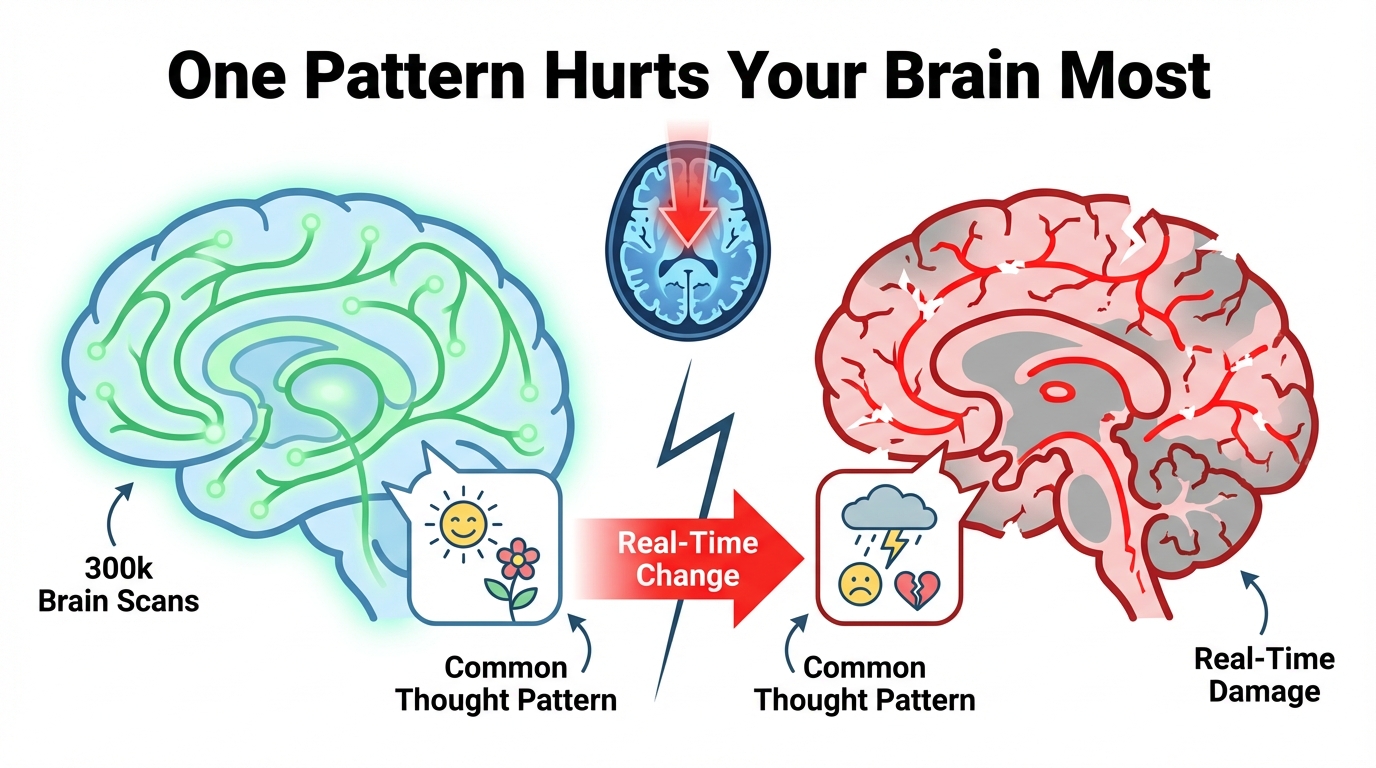
John: Alright, let’s break this down step by step, beginner-style. First, understand SPECT scans: These are like X-rays for brain activity, using radioactive tracers to map blood flow. Dr. Amen’s analysis of 300k scans revealed that negative thinking patterns—rumination, catastrophizing—correlate with “holes” in brain activity, meaning reduced function in areas like the temporal lobes (emotion processing).
Step 1: The trigger. A negative event happens (e.g., criticism at work). Your amygdala lights up, signaling “danger!”
Step 2: The loop. Instead of processing and moving on, you replay it, flooding your system with cortisol. This stresses the prefrontal cortex, impairing rational thinking.
Step 3: Long-term impact. Over time, this can lead to atrophy—brain shrinkage—and inflammation, potentially raising risks for mood disorders. One perspective is that it’s like revving a car engine in park; you’re burning fuel without progress, wearing out parts.
Lila: Love the car analogy! So, how does this compare to healthier patterns?
John: Exactly. Let’s table this out for clarity.
| Aspect | Old Way: Chronic Negative Thinking | New Way: Mindful Awareness |
|---|---|---|
| Brain Impact | Reduced blood flow, potential shrinkage in hippocampus and prefrontal cortex. | Increased neuroplasticity, stronger connections in emotional regulation areas. |
| Emotional Cost | Heightened anxiety, depression risk; feels like an endless loop. | Greater resilience; breaks the cycle with gratitude or reframing. |
| Daily Energy | Drains mental resources, leading to fatigue. | Frees up energy for productive tasks, like a mental battery recharge. |
| Long-Term Risks | Potential links to cognitive decline, per research. | May support brain health and longevity, based on studies. |
John: See? The new way isn’t about forcing positivity—it’s about awareness. Research suggests practices like mindfulness can rewrite these patterns, boosting brain health without the side effects of unchecked negativity.
Practical Use Cases & Application
Lila: So, how does this play out in real life? Give us some examples.
John: Absolutely. Let’s get concrete.
Example 1: At work. Instead of ruminating on a failed presentation (“I’m such a loser”), reframe it: “What can I learn?” This shifts brain activity from fear to growth, potentially improving performance over time.
Example 2: In relationships. Chronic negativity might magnify small arguments into catastrophes. Awareness helps: Notice the pattern, take a breath, and respond thoughtfully. Research suggests this builds emotional intelligence, leading to healthier bonds.
Example 3: Daily wellness. During exercise, negative self-talk (“I can’t do this”) hampers motivation. Flipping to encouragement activates reward centers, making habits stickier.
Example 4: Long-term planning. For stress about the future, negativity amplifies worst-case scenarios. Balancing with evidence-based optimism can enhance decision-making, like in career choices.
These aren’t magic fixes—results vary—but they illustrate how tweaking thought patterns can ripple into better daily life.
Educational Action Plan (How to Start)
John: Ready to experiment? Here’s a step-by-step, no-fluff plan. Remember, this is educational—consult pros for personalized advice.
Lila: Level 1 (Learn): What first?
John: Start by reading accessible resources. Check out books like “The Power of Habit” by Charles Duhigg for habit loops, or watch TED Talks on neuroplasticity. Follow reputable sites like Harvard Health for brain science basics.
Level 2 (Try Safely): Begin small. Track thoughts for a week in a journal—note negative patterns without judgment. Then, practice reframing: For each negative thought, counter with three neutral or positive facts. Try a 5-minute daily meditation via free apps (no promotions here). Measure progress by mood tracking, but keep it low-stakes to avoid overwhelm. Research suggests starting tiny builds momentum.
Lila: Love that—safe and scalable!
Conclusion & Future Outlook
John: Wrapping up: The risks of negative thinking? Brain strain, emotional toll, potential health dips. Rewards of awareness? Sharper mind, better resilience, possibly longer cognitive health. Effort vs. gain: Minimal daily tweaks yield compounding benefits, but it’s not effortless—consistency is key.
Uncertainty looms; brain science evolves, and individual factors vary. Watch for advancements in AI-driven mood tracking or new imaging tech. Stay curious, stay balanced.
Lila: Thanks, John—empowering stuff without the lectures.

👨💻 Author: SnowJon (Web3 & AI Practitioner / Investor)
A researcher who leverages knowledge gained from the University of Tokyo Blockchain Innovation Program to share practical insights on Web3 and AI technologies.
His motto is to translate complex technologies into forms that anyone can evaluate and use responsibly, fusing academic knowledge with practical experience.
*AI may assist drafting and structuring, but final verification and responsibility remain with the human author.
References
- This MD Analyzed 300k Brain Scans — This One Pattern Hurts Your Brain The Most
- Amen Clinics Official Website
- Harvard Health: How Your Brain Works
- NCBI: Neuroplasticity and Cognitive Function
- APA: Mindfulness Resources