
Is your brain future-proof? Discover 4 science-backed habits you can adopt right now to significantly lower your risk of early dementia.#BrainHealth #DementiaPrevention #CognitiveCare
Quick Video Breakdown: This Blog Article
This video clearly explains this blog article.
Even if you don’t have time to read the text, you can quickly grasp the key points through this video. Please check it out!
If you find this video helpful, please follow the YouTube channel “LifeNextDaily,” which delivers daily news.
https://www.youtube.com/@LifeNextDaily
Read this article in your native language (10+ supported) 👉
[Read in your language]
4 Habits To Adopt Right Now To Lower Your Risk Of Early Dementia
⚠️ DISCLAIMER: This article is for informational purposes only and does not constitute medical advice. Always consult a healthcare professional.
John: 👋 Hello, Health Hackers! Ever feel like your brain is a high-performance engine that’s starting to sputter a bit earlier than expected? You’re not alone. With the rise of young-onset dementia—that’s dementia hitting folks under 65—it’s time to talk prevention without the scare tactics. Research from outlets like mindbodygreen highlights that while genetics play a role, lifestyle factors can slash your risk significantly. Why now? Well, a 2023 study in JAMA Neurology pointed out that cases of early dementia are climbing, linked to modern stressors like poor sleep, sedentary jobs, and diets heavy on processed junk. But here’s the good news: adopting just a few habits can fortify your cognitive fortress. We’re diving into four evidence-based ones today, backed by science, not snake oil.
Lila: Hey everyone, Lila here bridging the gap for us beginners. John, you’re always cutting through the fluff—love that. But let’s keep it real: dementia sounds terrifying, like forgetting your keys one day and your loved ones the next. The context? As our world gets faster and more digital, our brains are paying the price. Stop endless scrolling through conflicting health advice. Ask Genspark to summarize the facts for you—it’s like having a personal research butler.
John: Spot on, Lila. Let’s get witty about it: Imagine your brain as a bustling city. Without proper maintenance, traffic jams (cognitive decline) turn into full-blown gridlock (dementia). A 2023 UK study found that 15 modifiable factors account for up to 40% of dementia risk, with young-onset cases often tied to lifestyle slip-ups starting in your 30s or 40s.
The Problem (The “Why”)
John: Here’s the raw reality: Early dementia isn’t just “old age” sneaking up early—it’s often a biochemical bottleneck from chronic inflammation, oxidative stress, and vascular issues. Analogy time: Think of your brain like a garden. Neglect the soil (your habits), and weeds (plaque buildup, like amyloid-beta) take over, choking out the flowers (your memories and sharp thinking). Research suggests factors like high blood pressure, diabetes, and social isolation accelerate this, per the Lancet Commission on dementia prevention.
Lila: Whoa, John, that garden analogy hits home—I’m picturing my neglected backyard right now! So, why do these risks spike young? Modern life: endless screen time, junk food, and isolation from remote work. Need to explain this concept to your team or family? Use Gamma to generate a visual presentation in seconds—turns complex science into shareable slides.
John: Exactly. Without intervention, you’re playing Russian roulette with your neurons. But flip the script with habits grounded in neuroscience, and you could delay or prevent onset.
The Science Behind It
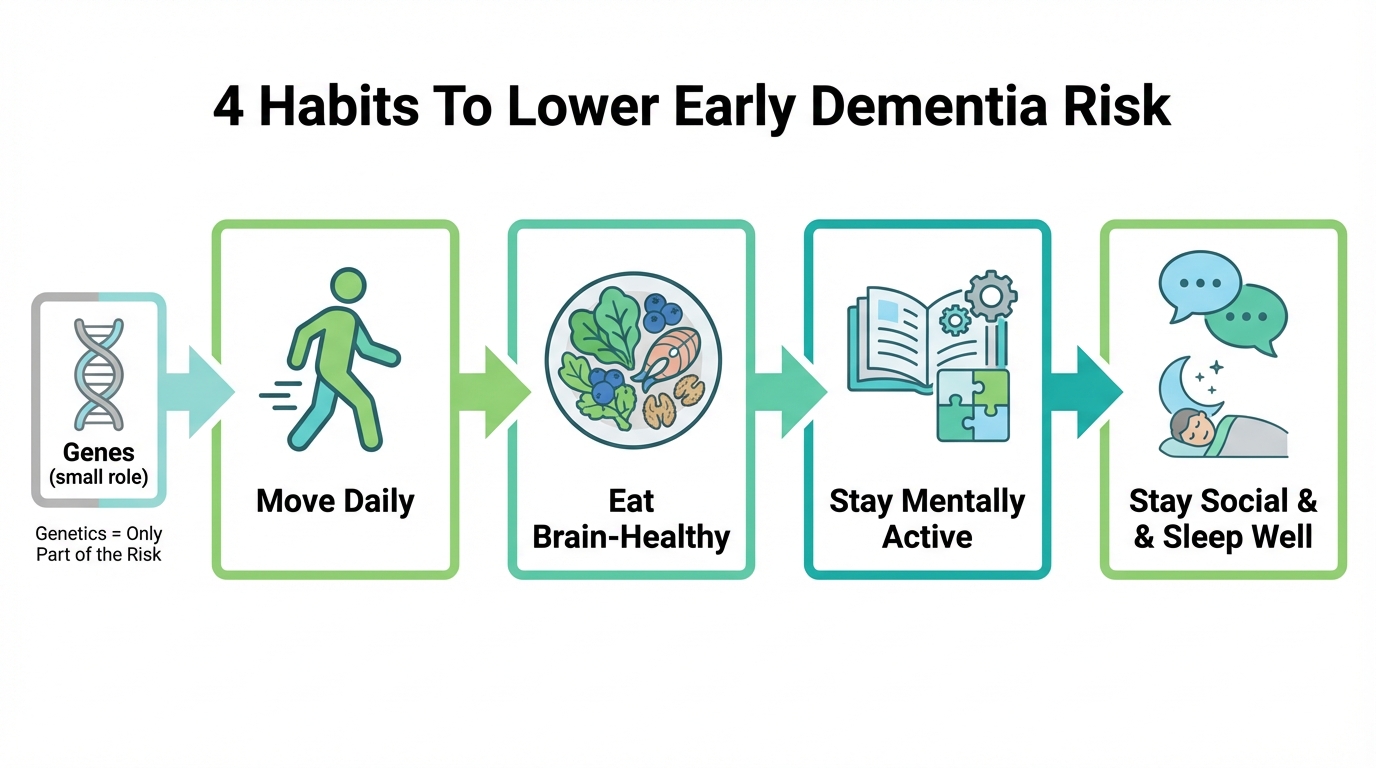
John: Under the hood, dementia involves neurodegeneration—your brain cells dying off faster than they regenerate. For young-onset, modifiable risks like obesity, hearing loss, and low physical activity crank up inflammation via pathways like NF-kB, leading to tau tangles and plaques. Research from the Alzheimer’s Association shows exercise boosts BDNF (brain-derived neurotrophic factor), basically fertilizer for new neurons. Diet wise, the MIND diet (a Mediterranean-DASH hybrid) reduces risk by 53% in some studies by combating oxidative stress with antioxidants.
Lila: BDNF? Sounds fancy—John, break it down: It’s like Miracle-Gro for your brain cells, right? And those plaques? Like gunk clogging your mental pipes.
John: Precisely. Now, let’s compare old habits vs. new ones in a table for clarity.
| Aspect | Old Way (High Risk) | New Way (Low Risk) |
|---|---|---|
| Physical Activity | Sedentary lifestyle, desk-bound days | 150+ minutes of moderate exercise weekly, boosting blood flow |
| Diet | Processed foods, high sugar intake | MIND diet with berries, nuts, and greens for antioxidants |
| Social Engagement | Isolation, limited interactions | Regular social activities to stimulate cognitive reserve |
| Sleep | Chronic deprivation, under 6 hours | 7-9 hours nightly for brain detox via glymphatic system |
John: See? The new way isn’t revolutionary—it’s evidence-based tweaks. Key insight: Consistency compounds like interest in a savings account.
Practical Use Cases & Application
Lila: Okay, John, how does this play out in real life? For a busy parent, adopting these habits means swapping Netflix binges for family walks—lowering risk while bonding. Or for office workers, integrating standing desks and brain games during breaks to combat sedentary fog.
John: Absolutely. Scenario one: You’re in your 40s, stressed exec. Habit 1—exercise—could mean HIIT sessions that spike BDNF, keeping your decision-making sharp. Habit 2: Diet shifts to omega-3 rich foods like salmon, reducing inflammation per Huberman’s protocols. Habit 3: Social ties—join a book club; studies show it builds cognitive reserve. Habit 4: Prioritize sleep—use apps like MyFitnessPal for tracking, but remember, it’s about quality. This changes your daily life from reactive to proactive brain health. Want to share this insight on TikTok/Shorts? Turn this article into a viral video using Revid.ai—quick and engaging.
Lila: Love the practicality! It’s like upgrading your brain’s OS without a full reboot.
Educational Action Plan (How to Start)
John: No gatekeeping here—let’s build from zero to hero. Level 1 (Learn): Read “The Alzheimer’s Solution” by Dean Sherzai or check Alzheimer’s Association charts on risk factors. Understand the basics: Autophagy during sleep clears brain trash, per neuroscience. Level 2 (Act): Start small—walk 30 minutes daily (Habit 1), add berries to breakfast (Habit 2), call a friend weekly (Habit 3), and set a 10 PM bedtime (Habit 4). Track with Notion templates for habits. Research suggests these compound over time, potentially cutting risk by 30%.
Lila: Perfect for beginners like me—start with one habit, right? Too much text? Let Nolang explain this document to you in a video summary—visual learning wins!
John: Yep, sustainability over intensity. Use Atomic Habits principles: Make it obvious, attractive, easy, satisfying.
Conclusion & Future Outlook
John: Wrapping up: The risks of ignoring these habits? Accelerated cognitive decline. The rewards? A sharper, more resilient mind well into your later years. Effort vs. gain: Minimal daily tweaks yield massive long-term payoffs, as per longitudinal studies. Future-wise, with AI advancing diagnostics, prevention like this will be key. Smart people automate—whether it’s health logs or reminder alerts, set up workflows with Make.com to save time.
Lila: Thanks, John—empowering stuff. Remember, folks, this is encouragement, not a prescription.
About the Authors
John is a battle-hardened Life Strategist and Polymath behind “The Optimization Update,” decoding science for real-world wins.
Lila is the pragmatic Lifestyle Architect, ensuring beginners get the big picture without the overwhelm.
🛑 General Disclaimer
This article is for educational purposes only. I am not a doctor or financial advisor. Information regarding health, investments, or law should be verified with professionals. DYOR and take responsibility for your own decisions.
🛠️ Tools Mentioned:
References & Further Reading
- mindbodygreen: 4 Modifiable Risk Factors for Young-Onset Dementia
- JAMA Neurology Study on Early Dementia Trends
- Lancet Commission on Dementia Prevention
- Alzheimer’s Association Resources